10 Best Rated Visa Credit Cards in 2026
The best Visa credit cards in 2026 combine near-universal acceptance with rewards, travel benefits, introductory financing or straightforward cash back, but the Visa logo alone does not determine a card’s value. Visa operates the payment network, while banks such as Chase, Capital One, Wells Fargo, Bank of America and U.S. Bank establish the rewards, fees, approval standards and most account terms. This ranked guide compares ten leading consumer Visa cards for different kinds of cardholders, from occasional travelers seeking a modest annual fee to frequent flyers who can use airport lounges and large annual credits. It also includes no-annual-fee options for dining, gas, online shopping, Amazon purchases, balance transfers and general spending. Our best overall choice is the Chase Sapphire Preferred® Card because its current welcome offer, useful bonus categories, travel protections and manageable $95 annual fee form one of the most balanced packages available. Capital One Venture X takes the premium-value position, while U.S. Bank Shield leads for a long introductory APR. Since the strongest card depends on where a person spends and whether they pay in full, every review below explains both the attractive features and the limitations that can reduce real-world value.
Important Note About Visa Credit Card Offers in 2026
Credit card bonuses, annual fees, reward categories, introductory APR periods, transfer fees, benefits and approval requirements can change without notice, so the information in this article is reviewed as of August 18, 2026 and should be confirmed on the issuer’s official application page before applying. A bonus displayed to one applicant may also differ from a public offer because issuers sometimes use targeted, in-branch, preapproved or limited-time promotions. Variable APRs generally move with the prime rate, and the exact rate assigned within an advertised range depends on creditworthiness and other underwriting factors. “Price” in this guide primarily means the card’s annual fee, although a card can also create costs through interest, balance-transfer fees, foreign transaction fees, cash-advance fees, late fees or optional payment plans. Rewards are valuable only when they exceed those costs, and carrying a balance at a standard purchase APR can erase months of points or cash back. Visa benefits may vary by Visa Traditional, Visa Signature or Visa Infinite tier and by issuer, so a network-level benefit should not be assumed unless it appears in the card’s current benefit guide. Applicants should read the complete pricing disclosure and benefit terms before submitting an application.
What Are the Best Visa Credit Cards in 2026?
The best Visa credit card is the one that produces the highest usable value after annual fees and without encouraging unnecessary spending. For most rewards-focused consumers, Chase Sapphire Preferred offers the strongest overall compromise: it earns elevated points in major travel and dining categories, includes meaningful travel protections, provides an annual hotel credit and keeps its annual fee below premium-card territory. Capital One Venture X is more compelling for travelers willing to book through an issuer portal and use lounge access, because its annual travel credit and anniversary miles can offset much of its $395 price. Chase Sapphire Reserve supplies a broader luxury package, but its $795 fee demands disciplined use of several credits. Wells Fargo Autograph is the leading no-fee travel-and-dining alternative, while Chase Freedom Unlimited and Wells Fargo Active Cash are easier everyday earners. Bank of America Customized Cash Rewards rewards people who can select and manage a favored spending category, U.S. Bank Altitude Connect targets travel and gas, and Prime Visa excels inside the Amazon ecosystem. U.S. Bank Shield sacrifices a traditional welcome bonus and broad rewards in exchange for an unusually long introductory APR, making it the financing specialist of this list.
How We Rated the 10 Best Visa Credit Cards
Our 2026 Visa credit card ratings use a practical value framework rather than ranking cards by the size of one advertised bonus. We evaluated the annual fee, welcome-offer accessibility, ongoing reward rate, redemption flexibility, introductory and regular APR, balance-transfer pricing, foreign transaction fee, travel and purchase protections, statement credits, payment-network tier, and the amount of work required to recover the annual fee. We gave additional weight to benefits that ordinary cardholders can use repeatedly, such as broad dining rewards, simple flat-rate cash back, primary rental coverage, cell phone protection or an annual travel credit, while giving less weight to narrow credits that require a specific merchant, booking channel or enrollment step. The rankings also consider audience fit: a premium travel card should deliver premium travel value, while a no-fee cash-back card should be easy to use without complex calculations. Published credit requirements are not guarantees, so recommended credit descriptions are directional rather than promises of approval. Finally, we considered the risk that interest could overwhelm rewards. A card with a strong bonus but no introductory APR may be excellent for a person who pays in full and unsuitable for someone financing a purchase, which is why the list includes both rewards leaders and a dedicated 0% APR option.
Favorable Details About Visa Credit Cards
Visa cards are accepted by millions of merchants worldwide, and the network supports products ranging from no-fee starter rewards cards to feature-rich Visa Infinite accounts. The most favorable options in this ranking let consumers match rewards and protections to their actual spending instead of paying for prestige alone.
- Broad domestic and international merchant acceptance makes a Visa card practical as a primary payment method.
- Issuers offer competitive cash-back, transferable-point, travel-mile and introductory-APR products on the Visa network.
- Visa Signature and Visa Infinite cards may include travel, purchase, emergency and concierge benefits when the issuer elects to provide them.
- Several top Visa cards charge no annual fee, allowing rewards to remain profitable even for moderate spenders.
- No-foreign-transaction-fee Visa cards can reduce the cost and friction of purchases made outside the United States.
Unfavorable Details About Visa Credit Cards
The Visa name does not make every Visa card equally rewarding, inexpensive or protective. Most account economics come from the issuing bank, and even cards in the same network tier can have different insurance limits, exclusions, redemption rules and fees, so applicants must compare the specific product rather than rely on the logo.
- Regular variable APRs can be high enough to outweigh rewards quickly when a balance is carried month to month.
- Premium annual fees are paid upfront even when a cardholder later fails to use the included credits or lounge access.
- Issuer travel portals, merchant lists, quarterly caps and enrollment requirements can make headline reward rates less flexible than they appear.
- Welcome offers commonly require substantial spending within a short period and may be restricted for previous cardholders.
- Balance transfers, cash advances, foreign purchases and late payments can trigger separate fees that are not reflected in the annual fee.
1. Chase Sapphire Preferred® Credit Card – Best Overall Visa Credit Card

The Chase Sapphire Preferred® Credit Card ranks as the best overall Visa credit card in 2026 because it blends a strong current welcome offer with useful everyday categories and a fee that does not require a luxury-travel budget. New cardmembers can earn 75,000 Ultimate Rewards points after spending $5,000 in the first three months, a meaningful return for applicants who can meet the requirement through normal planned expenses. The card earns 5 points per dollar through Chase Travel, 3 points on dining, 3 points on eligible online grocery purchases and select streaming services, 2 points on other travel and 1 point elsewhere, with additional current categories for qualifying gas, electric-vehicle charging and vacation-home bookings. A yearly hotel credit of up to $100 on an eligible Chase Travel booking helps offset the $95 annual fee, and points can be transferred to participating airline and hotel partners. The card also carries no foreign transaction fee and includes valuable travel coverage, including primary rental-car collision coverage under current terms. Its weaknesses are the lack of a 0% introductory APR and the need to use Chase Travel for the highest earning rate and hotel credit. Even so, it offers a better combination of simplicity, transfer partners, protection and achievable annual-fee recovery than most mid-priced travel cards.
Chase Sapphire Preferred® Card Facts Table
| Feature | Details |
| Credit Card Issuer | Chase |
| Payment Network | Visa Signature® |
| Rewards Type | Travel Rewards Credit Card |
| Recommended Credit | Good Credit to Excellent Credit Score (690-850) |
| Annual Fee or Price | $95 |
| Rewards | 5x Chase Travel; 3x dining, eligible online grocery and select streaming; 2x other travel; 1x other purchases, plus current limited categories |
| Welcome Bonus | 75,000 points after $5,000 in purchases in the first 3 months |
| Intro APR | None advertised |
| Regular APR | 19.24%–27.49% variable |
| Balance Transfer Fee | Greater of $5 or 5% under current standard pricing; verify the application disclosure |
| Foreign Transaction Fee | $0 |
| Best For | Flexible travel rewards with a moderate annual fee |
| Notable Benefits | Up to $100 annual eligible hotel credit, transfer partners, primary rental coverage and travel protections |
Why Chase Sapphire Preferred® Ranks First
Chase Sapphire Preferred ranks first because its benefits are broad enough for regular travelers without imposing a premium-card price. The 75,000-point offer creates substantial first-year potential, but the card remains useful after the bonus through dining, travel and transfer-partner rewards. Its annual hotel credit can nearly neutralize the $95 fee for someone who makes one qualifying booking, while primary rental protection and other travel coverage can provide value that simple cash-back cards lack. The absence of an intro APR means it is best for people who pay in full, yet its combination of rewards, protections and manageable cost gives it the widest appeal in this ranking.
2. Capital One Venture X Rewards Credit Card – Best Premium Travel Value

The Capital One Venture X Rewards Credit Card is the premium Visa for travelers who want lounge access and simple base earnings without paying the even higher price of some luxury competitors. The card offers 75,000 bonus miles after $4,000 in purchases during the first three months and earns an uncomplicated 2 miles per dollar on most purchases. Bookings through Capital One Travel earn 10 miles per dollar on hotels and rental cars and 5 miles per dollar on flights and vacation rentals, while eligible Capital One Entertainment purchases can also earn an elevated rate. Its $395 annual fee looks substantial, but an annual $300 Capital One Travel credit and 10,000 anniversary miles can recover much of that cost for a cardholder who consistently uses the portal. The primary cardholder receives Capital One Lounge and participating Priority Pass access after enrollment, although 2026 guest rules can create added charges unless current spending requirements or access conditions are met. Additional strengths include no foreign transaction fee, transfer partners and an application-fee credit for Global Entry or TSA PreCheck. Venture X is less suitable for travelers who avoid portals, want free lounge guests without conditions or carry balances, because there is no purchase intro APR and the regular variable APR can be expensive. For organized travelers, however, it delivers premium value with fewer merchant-specific lifestyle credits than many rivals.
Capital One Venture X Card Facts Table
| Feature | Details |
| Credit Card Issuer | Capital One |
| Payment Network | Mastercard |
| Rewards Type | Travel Rewards Credit Card |
| Recommended Credit | Good Credit to Excellent Credit Score (690-850) |
| Annual Fee or Price | $395 |
| Rewards | 10x portal hotels and rental cars; 5x portal flights and vacation rentals; 2x other purchases |
| Welcome Bonus | 75,000 miles after $4,000 in purchases within 3 months |
| Intro APR | None advertised |
| Regular APR | 19.49%–28.49% variable |
| Balance Transfer Fee | Current transfer APR and any applicable fee are shown in the application disclosure |
| Foreign Transaction Fee | $0 |
| Best For | Premium travel benefits with simple 2x everyday miles |
| Notable Benefits | $300 annual portal travel credit, 10,000 anniversary miles, lounges, transfer partners and up to $120 trusted-traveler credit |
Why Capital One Venture X Ranks Second
Venture X ranks second because its recurring travel credit and anniversary miles can make a premium Visa Infinite card feel closer to a mid-tier card in net cost. Unlimited 2x miles simplify uncategorized spending, while lounge access, transfer partners and strong portal rates create meaningful travel upside. It trails Chase Sapphire Preferred because recovering its value requires a larger upfront fee, annual portal use and attention to updated lounge guest rules. Applicants who prefer direct airline and hotel bookings may also leave rewards on the table. For frequent travelers comfortable with Capital One Travel, it remains one of the strongest premium-value propositions in 2026.
3. Chase Sapphire Reserve® Credit Card – Best Luxury Travel Benefits

The Chase Sapphire Reserve® Credit Card is designed for high-spending travelers who can turn a large menu of credits and airport benefits into more value than its $795 annual fee. Its current offer awards 100,000 Ultimate Rewards points after $6,000 in purchases during the first three months. Ongoing rewards include 8 points per dollar through Chase Travel, 4 points on flights and hotels booked directly, 3 points on dining worldwide and 1 point on other purchases, generally after the annual travel credit is applied where relevant. The card automatically provides up to $300 in annual travel statement credits and adds airport lounge access through Chase Sapphire Lounges and participating Priority Pass locations, with current guest rules. It also advertises up to $500 annually for eligible prepaid stays through The Edit, divided into semiannual opportunities and subject to a two-night minimum, plus up to $300 in annual eligible dining credits at participating Sapphire Reserve Exclusive Tables restaurants. Travel protections, point transfers, a trusted-traveler application-fee credit and no foreign transaction fee deepen the package. The challenge is utilization: hotel and dining credits have booking rules, timing limits and merchant restrictions, and an authorized user costs extra. This is not a card to carry debt on, because it has no 0% purchase offer. Reserve is excellent when travel patterns already match the benefits, but poor value
Chase Sapphire Reserve® Card Facts Table
| Feature | Details |
| Credit Card Issuer | Chase |
| Payment Network | Visa |
| Reward Type | Travel Rewards Credit Card |
| Recommended Credit | Good Credit to Excellent Credit Score (690-850) |
| Annual Fee | $95 |
| Welcome Offer | Up to 100,000 Ultimate Rewards points |
| Welcome Offer Requirement | Spend $5,000 within the first 3 months |
| Chase Travel Rewards | 5X points |
| Dining Rewards | 3X points |
| Gas & EV Charging | 3X points |
| Qualifying Vacation Homes | 3X points |
| Eligible Online Groceries | 3X points |
| Select Streaming | 3X points |
| Other Qualifying Travel | 2X points |
| Other Purchases | 1X points |
| Annual Hotel Credit | Up to $100 |
| Global Entry/TSA PreCheck/NEXUS Credit | Up to $120 every 4 years |
| Foreign Transaction Fee | $0 |
| Rewards Program | Chase Ultimate Rewards |
| Best For | Flexible travel rewards |
Why Chase Sapphire Reserve® Ranks Third
Chase Sapphire Reserve ranks third because it can deliver exceptional travel value, yet its $795 annual fee narrows the audience considerably. The 100,000-point welcome offer, $300 general travel credit, strong direct-booking rates and broad lounge package are compelling, while premium hotel and dining credits can push the total value higher. However, several credits are segmented, merchant-specific or subject to booking conditions, making break-even math more demanding than with Venture X. It is the better luxury choice for travelers who already use the eligible services, but the wrong choice for people who would change normal spending just to activate every benefit.
4. Wells Fargo Autograph Journey℠ Visa® Credit Card – Best No-Annual-Fee Travel Rewards
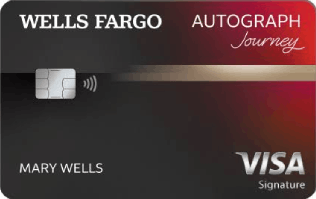
The Wells Fargo Autograph Journey℠ Visa® Credit Card proves that a useful travel-and-dining Visa does not need an annual fee. It earns 3 points per dollar across restaurants, travel, gas stations, electric-vehicle charging, transit, popular streaming services and phone plans, then 1 point per dollar on other purchases. That wide set of bonus categories fits commuters, diners and occasional travelers who do not want to track quarterly activations. New cardholders can earn 20,000 points after $1,000 in purchases during the first three months, and those points are worth $200 when redeemed for cash under the current offer. The card also provides 0% introductory APR on purchases for 12 months, followed by a variable APR of 18.49%, 24.49% or 28.49%, depending on creditworthiness. There is no foreign transaction fee, select transfer partners add travel flexibility, and cell phone protection can reimburse up to $600 per eligible claim after a $25 deductible when the monthly wireless bill is paid with the card, subject to terms. Limitations include the absence of premium lounge access, a smaller partner ecosystem than the largest travel programs and no promotional balance-transfer APR. Wells Fargo also applies product and account-opening eligibility rules that can affect a bonus or approval. Autograph is strongest for people who want broad bonus categories, international usability and no recurring fee rather than luxury perks.
Wells Fargo Autograph Journey℠ Visa® Card Facts Table
| Feature | Details |
| Credit Card Issuer | Wells Fargo Bank, N.A. |
| Payment Network | Visa Signature |
| Rewards Type | Travel Rewards Credit Card |
| Recommended Credit | Excellent Credit Score (690-850) |
| Annual Fee or Price | $95 |
| Rewards | 5X hotels; 4X airlines; 3X restaurants and other travel; 1X other purchases |
| Welcome Bonus | 60,000 points after $4,000 in purchases within 3 months |
| Intro APR | None |
| Regular APR | 19.49%, 25.49%, or 28.49% variable, based on creditworthiness |
| Balance Transfer Fee | 3% for qualifying transfers within 120 days, then up to 5%; $5 minimum |
| Foreign Transaction Fee | None |
| Best For | High direct-booking travel rewards at a moderate annual fee |
| Notable Benefits | $50 annual airline credit, transfer partners, cell phone protection, travel protections |
Why Wells Fargo Autograph® Ranks Fourth
Wells Fargo Autograph ranks fourth because it covers more common 3x categories than many no-annual-fee competitors and remains useful abroad with no foreign transaction fee. The modest spending requirement makes its bonus accessible, and the purchase intro APR provides breathing room for a planned expense. It cannot match the lounge access, credits or transfer depth of the top three travel cards, and it is not the best vehicle for a balance transfer. Still, for an occasional traveler who values dining, gas, transit, streaming and phone-plan rewards in one account, Autograph delivers unusually complete value at a $0 annual price.
5. Chase Freedom Unlimited® Credit Card – Best Flexible Everyday Cash Back

The Chase Freedom Unlimited® Credit Card is a versatile no-annual-fee Visa that combines a dependable floor with targeted bonus categories. It earns at least 1.5% cash back on ordinary purchases, 3% at restaurants and drugstores, and 5% on eligible travel bought through Chase Travel. New cardmembers can earn a $200 bonus after spending $500 in the first three months, a low threshold that is easier to reach without changing normal purchasing behavior. The card also advertises 0% introductory APR for 15 months on purchases and balance transfers, followed by a variable APR of 18.24%–27.74%. Transfers generally must be completed under the promotional terms and carry a fee, so the fee needs to be included in any savings calculation. Freedom Unlimited becomes especially valuable for people who also hold an eligible premium Chase card, because combining rewards may unlock airline and hotel transfers or other travel-redemption options unavailable through Freedom Unlimited alone. On its own, it remains a strong cash-back account. The largest drawback for travelers is a 3% foreign transaction fee, which makes another card preferable outside the United States. It also lacks the flat 2% base rate of Active Cash. Even so, its dining and drugstore categories, bonus, intro APR and broader Chase ecosystem make it a flexible long-term choice for many households.
Chase Freedom Unlimited® Card Facts Table
| Feature | Details |
| Credit Card Issuer | Chase |
| Card Network | Visa |
| Card Type | Cash Back Rewards Credit Card |
| Recommended Credit | Good Credit to Excellent Credit Score (690-850) |
| Annual Fee | $0 |
| Current Welcome Offer | $200 bonus |
| Welcome Offer Requirement | Spend $500 within the first 3 months |
| Chase Travel Rewards | 5% cash back |
| Dining Rewards | 3% cash back |
| Drugstore Rewards | 3% cash back |
| Other Purchases | 1.5% cash back |
| Foreign Transaction Fee | Applies |
| Rewards Program | Chase Ultimate Rewards |
| Purchase Protection | Available on eligible purchases |
| Trip Cancellation/Interruption Coverage | Available on qualifying purchases |
| Best For | Everyday cash back and Chase rewards users |
Why Chase Freedom Unlimited® Ranks Fifth
Freedom Unlimited ranks fifth because its 1.5% base return is not class-leading, but the total package is more flexible than the base rate suggests. Dining and drugstore rewards, a low-threshold $200 bonus and a 15-month purchase-and-transfer intro APR create both immediate and ongoing value. Its ability to complement an eligible Chase travel card is a major strategic advantage. The 3% foreign transaction fee and balance-transfer fee prevent it from being the best international or pure debt-transfer option, while consumers seeking maximum simplicity may prefer flat 2% rewards. It remains an excellent domestic everyday Visa with no annual fee.
6. Wells Fargo Active Cash® Credit Card – Best Flat-Rate Cash Back

The Wells Fargo Active Cash® Credit Card is one of the simplest high-quality Visa products in 2026: it earns unlimited 2% cash rewards on purchases without rotating categories, activation requirements or an annual fee. That structure works well for spending that often falls outside travel, dining, gas and grocery bonuses, including medical bills, home services, insurance payments and general retail purchases when a card is accepted without a surcharge. The current welcome offer provides a $200 cash rewards bonus after $500 in purchases during the first three months. New accounts also receive 0% introductory APR for 12 months on purchases and qualifying balance transfers, with transfers requested in the first 120 days; the subsequent variable APR is 18.49%, 24.49% or 28.49%. The introductory transfer fee is the greater of $5 or 3% during the first 120 days, then up to 5% with a $5 minimum, so Shield may be better for a large transfer requiring more time despite its higher transfer fee. Active Cash adds cell phone protection of up to $600 per eligible claim after a $25 deductible when requirements are satisfied. Its biggest drawback is a 3% foreign transaction fee, and it lacks accelerated categories above 2%. Wells Fargo eligibility rules can also limit bonuses for recent cardholders. For uncomplicated domestic cash back, however, few cards are easier to recommend.
Wells Fargo Active Cash® Card Facts Table
| Feature | Details |
| Credit Card Issuer | Wells Fargo Bank, N.A. |
| Payment Network | Visa Signature |
| Rewards Type | 0% Intro APR – Customized Cash Rewards |
| Recommended Credit Score | Good Credit to Excellent Credit Score (690-850) |
| Annual Fee or Price | $0 |
| Rewards | Unlimited 2% cash rewards on purchases |
| Welcome Bonus | $200 cash rewards after $500 in purchases in 3 months |
| Intro APR | 0% for 12 months on purchases and qualifying balance transfers |
| Regular APR | 18.49%, 24.49% or 28.49% variable |
| Balance Transfer Fee | Greater of $5 or 3% for 120 days, then up to 5% with a $5 minimum |
| Foreign Transaction Fee | 3% |
| Best For | Simple flat-rate cash back on domestic purchases |
| Notable Benefits | Cell phone protection, no reward categories to track and rewards that do not expire while the account remains open |
Why Wells Fargo Active Cash® Ranks Sixth
Active Cash ranks sixth because unlimited 2% rewards are easy to understand and competitive on purchases that receive only a base rate elsewhere. Its bonus, no annual fee, introductory APR and cell phone protection make it more than a bare-bones cash-back card. It sits below Freedom Unlimited because it lacks higher dining, drugstore and travel rates and has less potential inside a broader transferable-points strategy. The 3% foreign transaction fee also confines its strongest use case to domestic spending. For cardholders who want one predictable rate instead of optimizing categories, Active Cash may nevertheless be the most comfortable choice in the entire ranking.
7. Bank of America® Customized Cash Rewards Credit Card – Best Choice-Category Cash Back
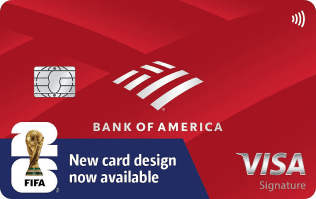
The Bank of America® Customized Cash Rewards Credit Card gives cardholders control over where they earn their highest cash-back rate. Its standard structure earns 3% in one selected category, 2% at grocery stores and wholesale clubs, and 1% on other purchases, with the 3% and 2% rates limited to the first $2,500 in combined category spending each quarter. Available choice categories include gas and EV charging, online shopping and eligible cable, internet and streaming, dining, travel, drugstores, and home improvement and furnishings, and the selection can generally be changed monthly. The current first-year promotion adds 3 percentage points to the choice category, producing 6% there during year one within the shared quarterly cap, while other rates follow the offer terms. New online applicants can also earn a $200 cash bonus after $1,000 in purchases within 90 days. The card charges no annual fee and offers 0% introductory APR for 15 billing cycles on purchases and qualifying balance transfers made within 60 days; the subsequent variable APR is 17.49%–27.49%. Transfers carry a 3% fee during the first 60 days, then 5%. Bank of America Preferred Rewards members may earn an additional relationship bonus on eligible rewards, making this card especially powerful for qualifying customers. Downsides include the quarterly cap, a 3% foreign transaction fee and the need to manage a choice category.
Bank of America® Customized Cash Rewards Card Facts Table
| Feature | Details |
| Credit Card Issuer | Bank of America, N.A. |
| Payment Network | Visa Signature |
| Rewards Type | 0% Intro APR – Customized Cash Rewards |
| Recommended Credit Score | Good Credit to Excellent Credit Score (690-850) |
| Annual Fee or Price | $0 |
| Rewards | First year: 6% selected category, 2% grocery and wholesale clubs and 1% other; standard selected-category rate becomes 3%, with a shared quarterly cap |
| Welcome Bonus | $200 online cash bonus after $1,000 in purchases in the first 90 days |
| Intro APR | 0% for 15 billing cycles on purchases and balance transfers made within 60 days |
| Regular APR | 17.49%–27.49% variable |
| Balance Transfer Fee | 3% for transfers made within 60 days, then 5% |
| Foreign Transaction Fee | 3% |
| Best For | Households that can concentrate spending in a chosen category |
| Notable Benefits | Monthly category choice and potential Preferred Rewards relationship bonus on eligible rewards |
Why Bank of America® Customized Cash Rewards Ranks Seventh
Customized Cash Rewards ranks seventh because its choice-category system can outperform flat-rate cards for a concentrated expense such as online shopping, dining or gas, and the first-year 6% promotion is especially attractive. The no-fee price, $200 bonus and 15-cycle intro APR make the opening package well rounded. It loses ground because the 3% and 2% categories share a $2,500 quarterly cap, foreign purchases cost extra and optimization requires occasional management. Qualifying Preferred Rewards customers may reasonably rank it much higher, while heavy category spenders who exceed the cap may need a companion card.
8. U.S. Bank Altitude® Connect Visa Signature® Credit Card – Best No-Fee Travel and Gas Rewards

The U.S. Bank Altitude® Connect Visa Signature® Credit Card targets travelers and drivers who want multiple travel features without an annual fee. It earns 5 points per dollar on prepaid hotels and rental cars booked through the U.S. Bank Travel Center, 4 points on travel, and 4 points at gas stations and EV charging stations on the first $1,000 in combined eligible spending each quarter. It also earns 2 points on dining, eligible streaming and grocery purchases, then 1 point on other purchases, with merchant-category exclusions detailed by U.S. Bank. The current welcome offer is 20,000 points after $1,000 in net purchases within 90 days. Cardholders receive 0% introductory APR for 15 billing cycles on purchases and balance transfers completed within the first 60 days, followed by a 17.49%–27.49% variable APR. A 5% transfer fee with a $5 minimum makes it less cost-efficient for moving debt than cards with a 3% initial fee. On the travel side, there is no foreign transaction fee, and current benefits include a trusted-traveler application-fee credit and limited Priority Pass Select access after enrollment under the program terms. The gas cap and portal requirement for 5x earnings reduce upside, while point redemption values can vary by method. Still, the combination of gas, travel, international use and intro financing is rare on a $0-annual-fee Visa.
U.S. Bank Altitude® Connect Visa Signature® Card Facts Table
| Feature | Details |
| Credit Card Issuer | U.S. Bank National |
| Payment Network | Visa Signature |
| Rewards Type | 0% Intro APR – Travel Rewards Credit Card |
| Recommended Credit Score | Good Credit to Excellent Credit Score (690-850) |
| Annual Fee or Price | $0 |
| Rewards | 5x eligible portal hotels and rental cars; 4x travel; 4x gas and EV charging on the first $1,000 quarterly; 2x dining, eligible streaming and grocery; 1x other |
| Welcome Bonus | 20,000 points after $1,000 in net purchases within 90 days |
| Intro APR | 0% for 15 billing cycles on purchases and transfers made within 60 days |
| Regular APR | 17.49%–27.49% variable |
| Balance Transfer Fee | 5% of each transfer, $5 minimum |
| Foreign Transaction Fee | $0 |
| Best For | Travel and gas rewards without an annual fee |
| Notable Benefits | Limited Priority Pass access, trusted-traveler application-fee credit and Visa Signature travel benefits under current terms |
Why U.S. Bank Altitude® Connect Ranks Eighth
Altitude Connect ranks eighth because it combines travel and gas rewards, no foreign transaction fee, an intro APR and selected travel benefits without charging an annual fee. Its 4x travel rate is competitive, and the trusted-traveler and limited lounge benefits are unusual at this price. The card ranks below Autograph because its gas bonus is capped, its top hotel and rental-car rate requires the U.S. Bank portal, and its 5% balance-transfer fee weakens the financing offer. It is nevertheless a strong choice for an occasional traveler or commuter who can stay within the quarterly gas cap and redeem points thoughtfully.
9. Amazon Prime Visa Credit Card – Best for Amazon and Whole Foods
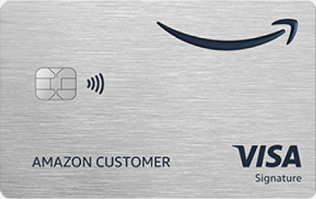
The Amazon Prime Visa Credit Card is the strongest Visa in this ranking for households that spend heavily with Amazon and Whole Foods Market and already pay for an eligible Prime membership. Approved Prime members can receive a $150 Amazon Gift Card instantly under the current public offer, avoiding a separate spending requirement. The card earns 5% back at Amazon.com, Audible.com, Whole Foods Market and Chase Travel with an eligible Prime membership, 2% at gas stations, restaurants and on local transit and commuting, and 1% on other purchases. Selected Amazon products and promotional categories can periodically earn 10% back or more, though those offers are limited and should not be treated as a universal rate. The card has no annual card fee and no foreign transaction fee, but Prime membership has a separate cost and is necessary for the richest reward tier; cardholders without eligible Prime status generally receive a lower return in core categories. The regular variable APR is 18.74%–27.49%, and there is no standard 0% introductory APR, so financing an Amazon purchase can quickly cost more than the rewards earned. Redemption is flexible for Amazon purchases, cash back and other options, but using rewards at checkout can forgo new rewards on that portion of a purchase. Prime Visa is an excellent ecosystem card, not the best general-purpose card for consumers who shop elsewhere.
Amazon Prime Visa Card Facts Table
| Feature | Details |
| Credit Card Issuer | Chase |
| Payment Network | Visa Signature® |
| Reward Type | Prime Visa official page |
| Recommended Credit Score | Good Credit to Excellent Credit Score (690-850) |
| Annual Fee or Price | $0 card fee; eligible Prime membership has a separate price |
| Rewards | 5% at Amazon.com, Audible.com, Whole Foods Market and Chase Travel with eligible Prime; 2% gas, dining and local transit; 1% other; selected promotions may earn more |
| Welcome Bonus | $150 Amazon Gift Card instantly upon approval for an eligible Prime member |
| Intro APR | None advertised |
| Regular APR | 18.74%–27.49% variable |
| Balance Transfer Fee | Greater of $5 or 5% under current standard pricing; verify the application disclosure |
| Foreign Transaction Fee | $0 |
| Best For | Frequent Amazon, Audible and Whole Foods purchases by Prime members |
| Notable Benefits | Instant gift-card offer, no foreign transaction fee and rotating selected Amazon earning opportunities |
Why Prime Visa Ranks Ninth
Prime Visa ranks ninth because it is exceptionally rewarding inside its intended ecosystem but less distinctive everywhere else. A Prime member who spends $5,000 annually across Amazon and Whole Foods could earn about $250 before promotional categories, making the card easy to justify when membership is already valuable independently. The instant gift card also avoids a spending hurdle. However, there is no intro APR, the 1% general rate is weak and the highest ongoing rates depend on maintaining eligible Prime status. It is a compelling specialized companion card, while the cards ranked above it serve a broader mix of everyday spending and travel needs.
10. U.S. Bank Shield™ Visa® Credit Card – Best 0% Intro APR and Balance Transfers

The U.S. Bank Shield® Visa® Credit Card is built for financing rather than maximizing a welcome bonus. Its headline feature is a limited-time 0% introductory APR for 21 billing cycles on purchases and balance transfers, with transfers required within 60 days of account opening. After the promotion, a variable APR of 16.99%–27.99% applies. Each balance transfer costs 5% of the amount with a $5 minimum, which is higher than the introductory fee on several shorter-duration cards, so applicants should compare the one-time fee with the additional interest-free months. The card charges no annual fee and offers a small ongoing value layer: 4% cash back on eligible prepaid air, hotel and car reservations booked through the U.S. Bank Travel Center, plus a $20 annual statement credit after 11 consecutive months of qualifying purchases under current terms. It also includes cell phone protection up to $600 when the monthly wireless bill is paid with the card and eligibility requirements are met. There is no traditional welcome bonus, general purchases outside the portal do not earn a competitive flat reward, and a 3% foreign transaction fee makes it unsuitable for international spending. Shield’s purpose is disciplined debt payoff or planned-purchase financing. A cardholder should calculate a monthly payment that eliminates the full balance before the promotion ends, because standard interest afterward can quickly reduce the savings.
U.S. Bank Shield™ Visa® Card Facts Table
| Feature | Details |
| Credit Card Issuer | U.S. Bank National |
| Payment Network | Visa |
| Reward Type | 0% Intro APR – Balance Transfer Credit Card |
| Recommended Credit Score | Good Credit to Excellent Credit Score (690-850) |
| Annual Fee or Price | $0 |
| Rewards | 4% cash back on eligible prepaid air, hotel and car reservations through the U.S. Bank Travel Center |
| Welcome Bonus | No traditional welcome bonus advertised |
| Intro APR | 0% for 21 billing cycles on purchases and balance transfers |
| Regular APR | 16.99%–27.99% variable |
| Balance Transfer Fee | 5% of each transfer, $5 minimum; transfers must be made within 60 days for the intro APR |
| Foreign Transaction Fee | 3% under current pricing; verify the application disclosure |
| Best For | Long purchase financing or balance-transfer payoff plans |
| Notable Benefits | $20 annual credit after 11 consecutive months of purchases, cell phone protection and one eligible $0-fee ExtendPay Plan annually under current terms |
Why U.S. Bank Shield™ Visa® Ranks Tenth
U.S. Bank Shield ranks tenth overall because it lacks the broad rewards and welcome bonuses that drive long-term value on the other cards, but it ranks first for a specific job: obtaining 21 billing cycles of introductory financing. That long runway can save meaningful interest when paired with a fixed payoff plan. The 5% transfer fee is a material upfront cost, and the card’s everyday earning is too narrow to make it an ideal primary rewards card after the promotion. Consumers with existing U.S. Bank balances also cannot transfer those balances to this account. Used strategically and paid off on time, Shield fills an important gap in a balanced Visa ranking.
10 Best Rated Visa Credit Cards in 2026 Comparison Table
| Credit Card | Intro Offer | Reward Rate | Annual Fee | Intro APR | Regular APR |
| Chase Sapphire Preferred® Card | 75,000 points | 1x–5x points | $95 | N/A | 19.24%–27.49% variable |
| Capital One Venture X Rewards Credit Card | 75,000 miles | 2x–10x miles | $395 | N/A | 19.49%–28.49% variable |
| Chase Sapphire Reserve® | 100,000 points | 1x–8x points | $795 | N/A | 19.49%–27.99% variable |
| Wells Fargo Autograph® Card | 20,000 points | 1x–3x points | $0 | 0% for 12 months on purchases | 18.49%, 24.49% or 28.49% variable |
| Chase Freedom Unlimited® | $200 cash back | 1.5%–5% cash back | $0 | 0% for 15 months on purchases and transfers | 18.24%–27.74% variable |
| Wells Fargo Active Cash® Card | $200 cash rewards | 2% cash rewards | $0 | 0% for 12 months on purchases and qualifying transfers | 18.49%, 24.49% or 28.49% variable |
| Bank of America® Customized Cash Rewards Credit Card | $200 online cash bonus | 1%–6% cash back in year one | $0 | 0% for 15 billing cycles on purchases and eligible transfers | 17.49%–27.49% variable |
| U.S. Bank Altitude® Connect Visa Signature® Card | 20,000 points | 1x–5x points | $0 | 0% for 15 billing cycles on purchases and eligible transfers | 17.49%–27.49% variable |
| Prime Visa | $150 Amazon Gift Card | 1%–5% cash back, with select offers above 5% | $0 card fee | N/A | 18.74%–27.49% variable |
| U.S. Bank Shield™ Visa® Card | N/A | 4% on eligible portal travel | $0 | 0% for 21 billing cycles on purchases and transfers | 16.99%–27.99% variable |
How to Choose the Best Visa Credit Card for Your Spending
Start by separating the card’s payment network from its economic value: Visa acceptance is broadly useful, but the issuer decides the fee, rewards and most benefits. Review the previous three to six months of spending and estimate annual purchases in travel, dining, groceries, gas, Amazon, online shopping and uncategorized expenses. Multiply each amount by the card’s applicable reward rate, subtract the annual fee, and count a statement credit only if normal behavior would trigger it. Next, choose the redemption style you will actually use. Cash back is transparent, while transferable points can offer more travel value but require availability searches and program knowledge. If a card has a portal bonus, decide whether you are comfortable booking through that portal when price, cancellation and loyalty-credit differences are considered. Travelers should prioritize no foreign transaction fee and relevant protections; people carrying debt should prioritize a suitable intro APR over rewards. Finally, compare welcome-offer spending with planned expenses rather than increasing consumption to qualify. A two-card strategy can be sensible—for example, Autograph for 3x categories and Active Cash for uncategorized purchases—but only if additional accounts remain easy to monitor and pay in full.
Visa Travel Rewards Credit Cards Versus Visa Cash-Back Credit Cards
Visa travel cards and Visa cash-back cards can use the same payment network while serving very different goals. Travel cards such as Chase Sapphire Preferred, Venture X and Sapphire Reserve earn points or miles that may be transferred to loyalty partners, used through an issuer portal or redeemed in other ways. Their strongest value often comes from learning program rules, finding award availability and using annual credits, protections and lounge access. Cash-back cards such as Active Cash, Freedom Unlimited and Customized Cash Rewards make value easier to measure because rewards can generally be expressed directly in dollars, and most charge no annual fee. A traveler does not automatically need a travel card: someone who flies once a year may prefer cash back and buy any available fare, while a frequent traveler may save more with transfer partners and trip coverage. Autograph and Altitude Connect sit between the categories by offering travel-oriented bonus rates without annual fees. The best decision depends on redemption habits, not marketing labels. Consumers who dislike portals or loyalty programs should favor cash back, while those willing to plan can extract greater upside from flexible points. In both cases, paying the statement balance in full matters more than earning an extra percentage point.
How to Apply or Check for Visa Credit Card Preapproval
Before applying, use an issuer’s official preapproval or prequalification page when available, because it may indicate likely eligibility through a soft credit inquiry that ordinarily does not affect credit scores. A preapproved result is not a guarantee, and the final application can still require a hard inquiry, identity verification, income review and full underwriting. Check all three credit reports for errors, calculate current debt obligations, and confirm that the card’s required bonus spending fits the household budget. Issuers may also apply internal rules involving recently opened accounts, previous ownership of the same product, prior bonuses or the number of Wells Fargo, Chase, Capital One, Bank of America or U.S. Bank accounts opened within a stated period. Submit one carefully chosen application rather than several speculative applications close together, and use only the issuer’s secure official page. The application typically asks for legal name, address, Social Security number, employment status, income and housing payment. Income should be reported accurately under the issuer’s instructions, including only income the applicant is legally permitted to consider. If denied, read the adverse-action notice before calling reconsideration; it identifies the principal underwriting reasons and can reveal whether correcting an error or reducing existing balances should come before another application.
What Credit Score Is Needed for a Visa Credit Card?
There is no single credit score required for a Visa card because Visa does not approve the account; the issuing bank does. The ten products in this ranking generally target consumers with good to excellent credit, often interpreted as FICO scores beginning around the high 600s or low 700s, but no published range guarantees approval. Premium products such as Venture X and Sapphire Reserve usually demand stronger overall profiles than a score alone suggests, including reliable income, reasonable utilization, established account history and limited recent applications. Issuers may use different scoring models and credit bureaus, and they consider payment history, debt-to-income obligations, existing relationships and prior experience with the bank. A lower score can sometimes be offset by other strengths, while a high score can still be declined because of recent accounts, frozen reports, insufficient income or internal exposure limits. Consumers building credit should avoid applying solely because a card is on a “best” list and instead consider a secured or starter Visa that matches their current profile. To improve approval odds, pay every bill on time, reduce reported revolving utilization, dispute genuine report errors and avoid opening unnecessary accounts before an important application. Prequalification is helpful for narrowing options but remains an estimate rather than an approval promise.
Visa Credit Card Annual Fees, Prices and Break-Even Value
Annual-fee math should begin with cash-equivalent benefits that match existing behavior. Chase Sapphire Preferred costs $95, and its eligible annual hotel credit can recover up to $100 for someone who would make the qualifying Chase Travel booking anyway. Venture X costs $395, but its $300 portal travel credit and 10,000 anniversary miles can offset much of that amount when fully used; the calculation should discount either benefit if the portal price or restrictions are less favorable than booking directly. Sapphire Reserve’s $795 fee requires a more demanding analysis of the $300 travel credit, lounge usage, hotel and dining credits, insurance value and incremental rewards above a less expensive card. Do not value a credit at face value when it causes extra spending, expires unused or requires a merchant you would not otherwise choose. The other seven cards in this ranking have $0 annual fees, but “free” does not mean costless: interest, transfer fees, foreign transaction charges and missed-payment fees can still apply. A simple break-even formula is annual fee divided by the incremental reward rate. If a $95 card earns one percentage point more than a free alternative, approximately $9,500 in eligible annual spending is needed before credits and benefits to recover the fee.
Best Visa Credit Card for Cash Back in 2026
Wells Fargo Active Cash is the best Visa credit card for uncomplicated cash back in 2026 because its unlimited 2% return applies to nearly every purchase without a category calendar or annual fee. A household with $30,000 in eligible annual purchases would earn about $600 before considering the welcome offer, and the calculation remains easy to audit. Chase Freedom Unlimited can outperform it for dining, drugstore and Chase Travel purchases and may be more valuable when paired with an eligible Chase travel card, but its 1.5% base rate earns less on broad uncategorized spending. Bank of America Customized Cash Rewards is the better specialized choice for a selected category, especially during its current first-year promotion or for qualifying Preferred Rewards members, though its quarterly cap requires attention. Prime Visa wins specifically for eligible Prime members with high Amazon and Whole Foods spending. The right cash-back setup may therefore use two cards: a category card for its high-rate merchants and Active Cash for everything else. Consumers who travel internationally should replace Active Cash abroad because its foreign transaction fee exceeds the rewards earned. As always, cash back should be redeemed regularly and the statement balance paid in full, since even a 2% return is small compared with a variable purchase APR.
Best Visa Credit Card for Balance Transfers in 2026
U.S. Bank Shield is the best Visa credit card for balance transfers in this ranking because its limited-time 0% introductory APR lasts 21 billing cycles on transfers made within 60 days, giving disciplined borrowers a long payoff window. Its 5% transfer fee is not cheap: moving $10,000 would generally cost $500, so the applicant should compare that upfront amount with the interest expected on the existing account and with shorter offers charging a lower initial fee. Divide the transferred balance plus fee by the number of promotional months to establish a minimum monthly target, then automate a somewhat larger payment so the account reaches zero before the regular variable APR begins. Chase Freedom Unlimited and Active Cash offer shorter promotional periods and may be less expensive for a balance that can be repaid quickly, while Bank of America Customized Cash Rewards combines 15 billing cycles with a 3% fee for eligible transfers made during the initial window. Transfers cannot generally be made between cards issued by the same bank, and the credit limit may be lower than the requested amount. New purchases can also complicate grace periods or payoff allocation, so a transfer card is best kept separate from daily spending unless the entire purchase balance is also covered by a promotional APR.
Best Visa Credit Card for International Travel in 2026
Capital One Venture X is the best Visa credit card in this ranking for frequent international travel when the cardholder can use its $300 Capital One Travel credit and airport lounge program. Visa Infinite acceptance, no foreign transaction fee, a 2x base rate, transfer partners, trusted-traveler credit and premium travel protections make it a strong one-card companion abroad. Chase Sapphire Reserve can offer even more luxury value, direct flight and hotel rewards and broad travel coverage, but its $795 annual fee requires heavier utilization. Chase Sapphire Preferred is the best lower-cost international option for people who want transfer partners and travel protection without a premium fee, while Wells Fargo Autograph is the best no-annual-fee choice because it earns 3x in several travel and dining categories and charges no foreign transaction fee. U.S. Bank Altitude Connect is another capable free option, particularly for travelers who value its current travel and trusted-traveler benefits. Before departure, confirm the card is active, add it to a mobile wallet, carry a backup issued by a different bank and decline dynamic currency conversion so the purchase is processed in local currency. Also review lounge guest rules and insurance exclusions, since premium branding does not make every trip disruption or rental automatically covered.
Final Verdict: Which Visa Credit Card Is Best in 2026?
Chase Sapphire Preferred® Card is our best rated Visa credit card in 2026 because it gives the widest group of rewards-minded consumers a realistic path to value. Its 75,000-point welcome offer, travel and dining categories, transfer partners, annual eligible hotel credit, no foreign transaction fee and travel protections justify a manageable $95 annual fee for many cardholders who pay in full. Capital One Venture X is the better premium-value choice for travelers who will reliably use Capital One Travel and airport lounges, while Chase Sapphire Reserve is the luxury option for people who can maximize its extensive credits. At the no-fee level, Wells Fargo Autograph leads for travel and dining, Freedom Unlimited offers a flexible domestic rewards package, and Active Cash is the simplest flat-rate earner. Customized Cash Rewards serves category optimizers, Altitude Connect fits travelers and drivers, Prime Visa rewards committed Amazon households, and U.S. Bank Shield provides the longest introductory financing in this group. No single card wins every category, and a high advertised rate is irrelevant if it applies to spending a person does not have. Compare net annual value, redemption effort, financing needs and approval fit, then confirm the live terms on the issuer’s official page before applying. The best Visa is ultimately the lowest-cost card that rewards existing behavior without creating debt.