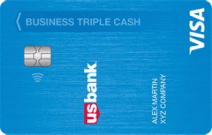

The U.S. Bank Triple Cash Rewards Visa® Business Credit Card is a versatile no-annual-fee business cash-back card designed for entrepreneurs, independent professionals and established companies that spend heavily on common operating expenses. Cardholders earn 5% cash back on eligible prepaid hotel and car rental reservations booked directly through the U.S. Bank Travel Center, 3% cash back at eligible gas and EV charging stations on transactions of $200 or less, office supply stores, cell phone service providers and restaurants, and 1% cash back on other eligible purchases. The card also offers a $750 introductory cash bonus after meeting the required Account Owner spending threshold, an annual $100 software subscription credit, free employee cards, U.S. Bank Spend Management and a 0% introductory APR on both purchases and balance transfers for 12 billing cycles. With a $0 annual fee and no overall cap on cash back earned, the Triple Cash Rewards Card delivers an unusually broad combination of rewards, business tools and introductory financing.
- $750 introductory cash-back bonus
- $0 annual fee
- Up to 5% cash back
- Unlimited 3% rewards in business categories
- 0% introductory APR for 12 billing cycles
- Only 1% cash back on general purchases
- 3% foreign transaction fee
- $200 Gas and EV Transaction Limit
- Welcome Bonus Requires Account Owner Spending/li>
- Travel Center Required for 5%
Favorable Details:
- $750 Welcome Bonus: Earn $750 cash back after making at least $6,000 in eligible net purchases on the Account Owner’s Card within the first 180 days after account opening.
- 5% Cash Back on Travel Center Hotels and Rental Cars: Eligible prepaid hotels and car rentals booked directly through the U.S. Bank Travel Center earn the card’s highest cash-back rate.
- 3% Cash Back at Gas and EV Charging Stations: Qualifying gas and electric vehicle charging purchases of $200 or less earn 3% cash back, subject to merchant eligibility rules.
- 3% Cash Back at Office Supply Stores: Eligible purchases at qualifying office supply merchants earn an elevated 3% rate without a published overall annual rewards cap.
- 3% Cash Back on Cell Phone Service: Eligible purchases directly from qualifying cell phone service providers earn 3% cash back.
- 3% Cash Back at Restaurants: Qualifying restaurant and restaurant-delivery transactions earn 3% cash back.
- Unlimited Overall Rewards: There is no overall limit on the total amount of cash back that can be earned.
- $100 Annual Software Credit: Receive an automatic $100 statement credit after meeting the requirements for 11 consecutive months of eligible software service purchases.
- $0 Annual Fee: Businesses can earn rewards and access card benefits without paying a yearly membership fee.
- 0% Intro APR: New accounts receive introductory 0% APR financing on purchases and qualifying balance transfers for 12 billing cycles.
- Free Employee Cards: Additional employee credit cards can be added without an annual employee card fee.
- Spend Management Tools: U.S. Bank Spend Management helps businesses monitor and control company card expenses.
Unfavorable Details:
- 1% Base Reward Rate: Purchases that do not qualify for the 3% or 5% categories earn only 1% cash back, which is lower than many flat-rate business cards.
- 3% Foreign Transaction Fee: The card can become expensive for international purchasing because foreign transactions generally incur an additional fee.
- $200 Gas and EV Transaction Limit: Individual qualifying gas or EV charging transactions exceeding $200 do not receive 3% cash back and generally earn only 1%.
- Welcome Bonus Requires Account Owner Spending: Purchases made on employee cards do not count toward the $6,000 spending requirement for the introductory bonus.
- Travel Center Required for 5%: The highest cash-back rate is limited to qualifying prepaid hotels and rental cars booked through U.S. Bank’s Travel Center.
- 5% Balance Transfer Fee: Qualifying balance transfers generally cost 5% of the amount transferred, subject to a $5 minimum.
- Merchant Coding Matters: Transactions must be submitted under an eligible Visa merchant category to earn the advertised bonus rate.
- Not Designed for International Spending: The foreign transaction fee makes competing no-foreign-transaction-fee business cards more attractive abroad.
- Strong Credit Profile Preferred: Applicants with damaged, thin or limited credit histories may face lower approval odds.
U.S. Bank Triple Cash Rewards Visa® Business Card Facts Table
| Feature | Details |
| Credit Card Issuer | U.S. Bank National Association |
| Payment Network | Visa |
| Reward Type | Business Cash Back Rewards |
| Recommended Credit | Good Credit to Excellent Credit Score (690-850) |
| Annual Fee | $0 |
| Employee Card Fee | $0 |
| Welcome Bonus | $750 cash back after $6,000 in eligible Account Owner purchases within 180 days |
| Maximum Reward Rate | 5% cash back |
| Travel Center Rewards | 5% on eligible prepaid hotels and car rentals |
| Business Bonus Categories | 3% at eligible gas/EV charging stations, office supply stores, cell phone service providers and restaurants |
| Other Purchases | 1% cash back |
| Rewards Limit | No overall limit on total cash back earned |
| Software Credit | $100 per 12-month period after qualifying recurring software purchases |
| Intro Purchase APR | 0% for 12 billing cycles |
| Intro Balance Transfer APR | 0% for 12 billing cycles |
| Regular APR | 17.24%–26.24% variable APR |
| Balance Transfer Fee | 5% of each transfer, $5 minimum |
| Foreign Transaction Fee | 3% |
| Expense Management | U.S. Bank Spend Management |
| Best For | Small businesses spending on office supplies, gas, cell service, restaurants and software |
Up to 5% Cash Back
The U.S. Bank Triple Cash Rewards Visa Business Card offers a tiered cash-back structure ranging from 1% to 5% on eligible purchases. Its highest rate applies to qualifying prepaid hotels and rental cars booked through the U.S. Bank Travel Center, while several common business categories earn 3% and all other eligible purchases generally earn 1%. Unlike cards with rotating quarterly bonus categories, Triple Cash keeps its primary categories consistent, making it easier for business owners to predict how much they can earn from recurring expenses.
How the U.S. Bank Triple Cash Rewards Business Card Works
The Triple Cash Rewards Card operates as a traditional revolving business credit card. Approved businesses receive a credit line that can be used for qualifying company purchases, while transactions earn cash back according to merchant category. Cardholders receive monthly billing statements and can pay the statement balance in full or carry an eligible balance subject to the applicable APR. During the introductory period, qualifying purchases and balance transfers can receive 0% APR for 12 billing cycles, potentially providing valuable short-term financing flexibility.
$0 Annual Fee
One of the strongest advantages of the U.S. Bank Triple Cash Rewards Visa Business Card is its $0 annual fee. Business owners do not need to calculate how much annual spending is required merely to recover a membership charge before earning a positive return. The absence of a yearly fee also makes the card easier to maintain over the long term, particularly for businesses that value its office supply, cell phone, restaurant and fuel categories but may not spend enough to justify a premium business card.
Free Employee Cards
Employee cards can be issued without an additional annual card fee, allowing businesses to extend purchasing authority to employees while keeping transactions centralized. Companies can use employee cards for travel, office supplies, client meals, fuel and other approved expenses instead of requiring workers to use personal cards and submit reimbursement requests. Employee cards can improve convenience and expense visibility, although the business should establish clear internal spending policies and monitor account activity regularly.
$750 Welcome Bonus
New eligible cardholders can earn $750 cash back after making at least $6,000 in eligible net purchases on the Account Owner’s Card within the first 180 days after account opening. This six-month spending window averages approximately $1,000 per month, making the requirement potentially attainable for many businesses through normal operating expenses. Purchases should be planned around actual business needs rather than created solely to earn the bonus because unnecessary spending can easily exceed the value of the $750 reward.
Employee Purchases Do Not Count Toward the Welcome Bonus
An important limitation of the introductory offer is that the $6,000 spending requirement applies specifically to the Account Owner’s Card. Purchases charged to employee cards do not count toward satisfying the welcome bonus requirement. A business that normally distributes expenses among multiple employees should therefore ensure that enough qualifying purchases are placed on the primary card during the first 180 days to trigger the $750 bonus.
5% Cash Back on Prepaid Hotels
Eligible prepaid hotel reservations booked through the U.S. Bank Travel Center earn 5% cash back. A company spending $5,000 annually on qualifying prepaid hotel stays could earn approximately $250 in cash back from that category. Businesses should still compare Travel Center prices, cancellation rules and hotel loyalty benefits against direct booking because earning an additional percentage of cash back may not compensate for a higher room price or lost hotel-program benefits.
5% Cash Back on Prepaid Car Rentals
Qualifying prepaid car rentals booked through the U.S. Bank Travel Center also earn 5% cash back, providing a useful bonus for companies whose employees regularly rent vehicles for meetings, site visits, conferences or sales trips. A business spending $3,000 annually on eligible rental cars through the Travel Center could earn approximately $150 in cash back. As with hotel reservations, the total rental price and booking terms should be considered alongside the reward rate.
3% Cash Back at Gas Stations
Eligible purchases at qualifying gas stations earn 3% cash back, making Triple Cash particularly attractive for businesses with employees who drive regularly. Contractors, real estate professionals, sales representatives, delivery businesses and service companies may all generate meaningful cash back from fuel expenses. However, the transaction must be $200 or less to qualify for the elevated automotive fuel reward, and purchases made through excluded merchant types may receive only the standard rate.
$200 Gas Transaction Limit
The 3% cash-back rate on gas applies only when an eligible transaction is $200 or less. A gasoline purchase exceeding that threshold is generally not treated as an eligible automotive fuel transaction for the bonus and instead earns the card’s lower base rate. This restriction should not affect most passenger-vehicle fill-ups, but businesses operating large trucks, commercial vehicles or other equipment with high fuel costs should keep the transaction limit in mind.
3% Cash Back at EV Charging Stations
Eligible electric vehicle charging transactions of $200 or less also earn 3% cash back, giving businesses with electric vehicles the same general elevated reward opportunity as companies using gasoline. This can be useful for companies transitioning to electric fleets or reimbursing employees for eligible charging expenses. Wholesale clubs, discount stores and supercenters are excluded from the qualifying automotive category, so merchant classification remains important.
3% Cash Back at Office Supply Stores
Office supply stores are one of Triple Cash’s strongest business-oriented bonus categories. Eligible purchases at merchants coded as office supply stores earn 3% cash back, allowing companies to receive elevated rewards on items such as printer supplies, paper, office furniture, small equipment and other qualifying purchases. Purchases made from general retailers or online marketplaces may not qualify even when the products themselves are office supplies because Visa merchant coding determines the applicable reward rate.
3% Cash Back on Cell Phone Service
Qualifying payments made directly to eligible cell phone service providers earn 3% cash back. Businesses maintaining multiple mobile lines can generate meaningful rewards from a recurring expense that must be paid every month. A company spending $500 per month on eligible wireless service would charge approximately $6,000 annually and could earn around $180 in cash back from that expense alone, assuming all transactions qualify for the advertised category.
3% Cash Back at Restaurants
Eligible restaurant and qualifying restaurant-delivery purchases earn 3% cash back, providing additional rewards for client meals, employee travel, business meetings and other company dining expenses. Unlike cards that restrict dining rewards to a small annual spending cap, Triple Cash does not advertise an overall cap on total cash back earned in the restaurant category. Merchant coding still determines eligibility, so purchases processed through hotels, entertainment venues or other establishments may not always receive the restaurant rate.
Restaurant Delivery Rewards
Eligible restaurant delivery transactions can also qualify for the 3% cash-back category when processed under an appropriate merchant classification. This can make the card useful for businesses ordering meals for employee meetings, training sessions or client events. Delivery fees, service charges and restaurant markups can still increase the total cost of an order, so companies should not choose delivery solely because the payment earns cash back.
1% Cash Back on Other Purchases
Eligible transactions outside the 3% and 5% bonus categories generally earn 1% cash back. This is the card’s most significant rewards weakness because numerous competing business cards offer 1.5% or 2% on general purchases. Businesses with large expenses in inventory, digital advertising, manufacturing supplies, professional services or other categories not specifically rewarded by Triple Cash may benefit from pairing the card with a higher flat-rate business card.
Unlimited Total Cash Back
The Triple Cash Rewards Card does not impose an overall limit on the total amount of cash back a business can earn. This is particularly valuable for companies with substantial spending in the 3% categories because rewards do not automatically drop to 1% after a small annual threshold. Individual category rules such as the $200 gas and EV transaction restriction still apply, but there is no general annual rewards ceiling.
$100 Annual Software Subscription Credit
The card offers an automatic $100 statement credit per 12-month period after 11 consecutive months of eligible software service purchases made directly with qualifying software service providers. Services such as accounting and business-management software may qualify when properly coded. For companies that already maintain recurring software subscriptions, the credit can provide meaningful savings without requiring additional discretionary spending.
How the Software Credit Works
To receive the annual $100 software credit, the card generally needs to be used for qualifying software service purchases during 11 consecutive months. The credit is then automatically applied to the account, subject to eligibility and processing requirements. Purchases made through discount retailers, general online marketplaces or merchants that are not coded as eligible software providers may not qualify even when the product purchased is a software subscription.
FreshBooks and QuickBooks Value
U.S. Bank uses services such as FreshBooks and QuickBooks as examples of the type of recurring software expenses that may qualify for the annual statement credit. Many small businesses already pay for accounting or bookkeeping software, making the benefit potentially easy to use without changing spending behavior. Businesses should still verify that the transaction is billed directly by an eligible provider and coded appropriately before relying on the credit.
0% Intro APR on Purchases
The Triple Cash Rewards Business Card provides a 0% introductory APR on purchases for the first 12 billing cycles, allowing businesses to temporarily finance eligible expenses without purchase interest. This can be useful for equipment, inventory, office improvements, technology upgrades or other planned costs. Business owners should establish a repayment schedule from the beginning so the promotional balance is eliminated before the standard variable APR begins.
0% Intro APR on Balance Transfers
Qualifying balance transfers can also receive a 0% introductory APR for 12 billing cycles, making the Triple Cash unusual among business cash-back cards. A company paying high interest on an existing eligible business credit card may be able to reduce financing costs by transferring debt, although the transfer fee must be considered. Balance transfers from another U.S. Bank account generally do not qualify.
5% Balance Transfer Fee
The introductory 0% balance transfer offer does not eliminate transaction costs. Each qualifying balance transfer generally carries a fee of 5% of the transferred amount, subject to a $5 minimum. A $10,000 transfer would therefore cost approximately $500 upfront. A business should calculate expected interest savings before transferring debt to determine whether the promotional financing benefit exceeds the fee.
17.24%–26.24% Variable APR
After the introductory period expires, eligible revolving balances are currently subject to a 17.24%–26.24% variable APR, depending on creditworthiness and other factors. Interest at those rates can quickly overwhelm the value of 1%, 3% or even 5% cash back. Businesses that regularly carry debt should prioritize financing costs over rewards and consider whether a dedicated low-interest business credit card would provide greater value.
Paying the Balance in Full
The most efficient way to use Triple Cash over the long term is generally to pay the statement balance in full by the due date. Paying in full helps preserve the full economic value of cash-back rewards and keeps routine business expenses from becoming expensive revolving debt. Companies using the introductory 0% APR should still make consistent monthly payments rather than waiting until the final billing cycle to address a large promotional balance.
U.S. Bank ExtendPay Plans
Eligible cardholders may receive access to U.S. Bank ExtendPay® Plans, which allow qualifying purchases to be divided into fixed monthly payments with a fixed monthly fee instead of traditional interest. New accounts may receive a $0-fee introductory opportunity on qualifying plans opened during the first 60 days after account opening. Availability is not guaranteed, and businesses should compare the total plan cost with simply paying the transaction in full.
U.S. Bank Spend Management
Triple Cash cardholders receive access to U.S. Bank Spend Management, a platform designed to help companies monitor and control business card spending. Businesses can use expense-management tools to improve visibility across card transactions and employee purchases, potentially reducing the administrative burden of manual expense reporting. For companies issuing multiple employee cards, integrated expense controls can provide value beyond the cash-back program itself.
Employee Expense Management
Providing employees with dedicated business cards can streamline purchasing while reducing the need for personal-card reimbursements. Company owners can review employee transactions within the U.S. Bank account environment and use spending-management features to help monitor expenses. Businesses should establish written purchasing policies, define appropriate uses and promptly address unfamiliar transactions because free employee cards increase convenience but also increase the number of people with access to company credit.
Flexible Cash-Back Redemption
Cash rewards can generally be redeemed for options including a statement credit, deposit into an eligible U.S. Bank account, U.S. Bank Rewards Card or eligible Real-Time Rewards redemption. Businesses should compare redemption values because some reward methods can provide different values. Statement credits and qualifying account deposits can provide straightforward cash value for businesses that prefer financial savings over merchandise or travel rewards.
Statement Credit Redemption
Redeeming cash back as a statement credit can directly reduce the business card account balance. However, a statement credit does not replace the required minimum payment, so the account owner must still satisfy the normal payment obligation shown on the statement. Businesses should treat rewards as a financial benefit rather than part of the monthly payment strategy.
U.S. Bank Account Deposit Redemption
Eligible cash rewards may also be deposited into a qualifying U.S. Bank deposit account. For businesses already using U.S. Bank checking or other eligible banking products, this redemption method can make rewards feel more like traditional cash income. A separate U.S. Bank deposit relationship is not necessarily required to obtain the credit card, so businesses can still use other available redemption choices.
Real-Time Rewards
Real-Time Rewards allows enrolled Triple Cash cardholders to redeem available cash rewards immediately after certain qualifying purchases. When an eligible transaction posts and the account has enough rewards to cover it, the cardholder may receive a text message with an option to redeem. Responding according to the instructions applies the reward as a statement credit, making the process more convenient than manually logging into the rewards center.
Cash-Back Expiration
Cash rewards can generally remain available while the account stays active and maintains qualifying activity, but U.S. Bank’s program terms include an inactivity rule. Rewards can expire after 12 consecutive statement cycles without qualifying reward, purchase or balance activity. Businesses using the card regularly should have little difficulty maintaining activity, while owners planning to stop using the account should consider redeeming accumulated rewards first.
No Rotating Reward Categories
The Triple Cash Card does not rely on rotating quarterly bonus categories that require activation. Gas and EV charging stations, office supply stores, cell phone service providers and restaurants remain the principal 3% categories, while qualifying prepaid Travel Center hotels and rental cars earn 5%. This consistency makes the card easier to manage than products whose best reward categories change every three months.
Merchant Category Coding
Cash-back eligibility is determined largely by the merchant category code assigned through Visa’s payment network. Buying printer paper at a dedicated office supply store may earn 3%, while buying the same item from a warehouse club or general online retailer may earn only 1%. Similarly, a restaurant operating inside another business may not always be coded as a restaurant. Businesses should therefore focus on how the merchant processes the transaction rather than merely what was purchased.
Rewards on Returned Purchases
Cash back is earned on eligible net purchases, meaning purchases after credits and returns are taken into account. When a company returns an item or receives a merchant refund, rewards associated with that transaction can be reduced or reversed. Cash advances, balance transfers, interest charges, fees and various cash-equivalent transactions also generally do not qualify for rewards.
3% Foreign Transaction Fee
The Triple Cash Rewards Card generally charges a 3% foreign transaction fee, which is one of its clearest disadvantages. A business making $20,000 of qualifying international purchases could incur approximately $600 in additional foreign transaction charges. Companies that regularly travel internationally, import goods or pay overseas vendors should consider pairing Triple Cash with a business card that does not charge foreign transaction fees.
Visa Payment Network
Because Triple Cash operates on the Visa network, cardholders benefit from extensive merchant acceptance throughout the United States and internationally. Visa acceptance can make the card practical for office suppliers, restaurants, fuel stations, software providers and numerous other business expenses. The card’s 3% foreign transaction fee, however, means broad international acceptance should not be confused with being an ideal international payment card.
Business Expense Separation
Using Triple Cash exclusively for company purchases can help entrepreneurs separate personal and business expenses. Maintaining this distinction can simplify bookkeeping, expense reports and preparation of financial records. A dedicated business card also reduces the need to identify company charges buried among personal purchases at the end of each month, although business owners should still maintain accurate accounting records independently of the credit-card statement.
Cash Flow Management
The card’s introductory 0% APR can provide useful short-term cash-flow flexibility, particularly when business expenses arrive before customer payments. A company may be able to purchase inventory or equipment and repay the amount gradually during the promotional period without interest. This feature should be used strategically rather than as a substitute for sustainable cash flow because the account eventually converts to a relatively high variable APR.
Credit Limit
U.S. Bank does not publish a single credit limit that applies to every Triple Cash applicant. The approved amount can depend on factors such as personal credit history, business revenue, income, existing obligations and overall underwriting results. Some businesses may receive relatively modest starting lines while established companies with stronger financial profiles may receive larger amounts.
Minimum Credit Line
Approved applicants may receive different credit lines depending on underwriting, with reported minimum approvals commonly beginning around the low-thousands range. A company expecting to make large inventory or equipment purchases should not assume approval automatically provides enough available credit for every planned transaction. Businesses can evaluate the approved limit before deciding how extensively to integrate the card into operating expenses.
Credit Limit Increases
Responsible account management can potentially improve eligibility for a future credit-line increase. Consistent payments, growing business revenue, lower revolving balances and responsible use of the existing line may strengthen the account profile. A larger credit limit can provide additional purchasing flexibility, but businesses should not increase spending simply because more credit becomes available.
Good-to-Excellent-Credit Applicants
The U.S. Bank Triple Cash Rewards Visa Business Card is generally best suited to applicants with good to excellent personal credit and a demonstrated ability to manage debt responsibly. A particular credit score does not guarantee approval because U.S. Bank may also consider business revenue, income, existing obligations, payment history, recent applications and other underwriting factors.
Applying for the Triple Cash Rewards Business Card
The application process generally requires information about both the applicant and the business. Applicants may need to provide their legal name, Social Security number, residential address, income information and ownership details along with the company’s legal name, business address, industry, organizational structure, tax identification number when applicable, annual revenue and time in business. Providing complete and accurate information can reduce delays during underwriting.
Sole Proprietors
Sole proprietors may potentially apply for the Triple Cash Rewards Card even if they do not operate a large corporation. Freelancers, consultants, contractors, online sellers, independent professionals and other self-employed individuals may have qualifying business activity. Applicants should provide accurate information about their business structure and income rather than assuming a formal corporation is required for every business credit-card application.
Startups and New Businesses
New businesses can potentially qualify for a U.S. Bank business credit card even when they do not have years of operating history. In these cases, the owner’s personal credit and financial profile can become especially important because the company itself may not have an established borrowing record. Startups should consider whether the Triple Cash reward categories and 0% APR offer fit expected expenses rather than choosing the card only for its welcome bonus.
Personal Guarantee Considerations
Business card issuers may require the owner to personally guarantee repayment of the account. A personal guarantee can make the individual responsible for outstanding balances if the business cannot repay its debt. Applicants should read the card agreement carefully and understand their obligations before submitting an application rather than assuming a business card completely separates personal financial liability.
Business Credit Building
Responsible use of the Triple Cash Rewards Card can become part of a company’s broader credit-management strategy. Consistent payments, careful borrowing and maintaining manageable balances can help establish a record of responsible business financing when account activity is reported to relevant commercial credit bureaus. Business owners should not rely on one card alone, however, because business creditworthiness can depend on numerous financial and operational factors.
Is the Triple Cash Rewards Card Good for Startups?
Triple Cash can be an attractive startup card because it combines no annual fee with a 12-billing-cycle introductory 0% APR period. A new company purchasing office supplies, phones, software or equipment may benefit from the financing flexibility while simultaneously earning cash back. The card becomes less compelling when most startup spending falls into categories earning only 1%, particularly when a competing flat-rate business card would provide a higher return.
Is the Triple Cash Rewards Card Good for Restaurants?
Restaurant businesses may benefit from the card for eligible purchases made at restaurant merchants, but the 3% dining category is generally more directly useful when the business itself purchases meals for travel, client meetings or employee events. Restaurants purchasing food inventory from wholesale suppliers should not assume those purchases qualify for 3% simply because the company operates in the restaurant industry; the merchant receiving the payment determines the category.
Is the Triple Cash Rewards Card Good for Contractors?
Contractors, home-service businesses and other mobile professionals can receive meaningful value from the combination of 3% gas rewards, 3% office supply rewards, 3% cell phone service rewards and no annual fee. Businesses that purchase substantial construction materials from home-improvement stores or specialized suppliers may receive only 1% on those transactions, so contractors with large uncategorized material expenses may benefit from pairing Triple Cash with a higher flat-rate card.
Is the Triple Cash Rewards Card Good for Freelancers?
Freelancers and independent professionals can find the Triple Cash Rewards Card useful when their expenses include wireless service, restaurants, office supplies, business travel and software subscriptions. The $0 annual fee makes the card easier to justify for smaller businesses that may not generate enough spending to offset a premium annual fee. Freelancers should still compare the 1% general rate with flat-rate alternatives if most of their expenses are advertising, professional services or other nonbonus purchases.
Is the Triple Cash Rewards Card Good for Travel?
Triple Cash provides a strong 5% cash-back rate on qualifying prepaid hotels and rental cars booked through the U.S. Bank Travel Center, but it is not primarily designed as a premium business travel card. It does not focus on broad airline rewards or international fee savings, and the 3% foreign transaction fee limits its usefulness abroad. Domestic businesses that occasionally book eligible hotels and rental cars may benefit more than companies with extensive global travel.
Is the Triple Cash Rewards Card Good for International Business?
The card is generally not ideal for substantial international spending because of its 3% foreign transaction fee. A business making frequent foreign purchases can lose more in transaction fees than it earns in cash back. Companies that primarily operate domestically but occasionally make international purchases may keep a separate no-foreign-transaction-fee card for overseas transactions while continuing to use Triple Cash for its stronger domestic categories.
U.S. Bank Triple Cash Rewards vs. Ink Business Cash®
The Ink Business Cash® Credit Card is a strong alternative for businesses spending heavily on office supply stores and telecommunications services because it can offer a higher reward rate in those categories up to an annual spending limit. Triple Cash provides 3% on office supplies and eligible cell phone service without the same overall rewards structure, while also including gas, EV charging and restaurants at 3% and an introductory balance-transfer APR. Ink Business Cash may produce higher rewards for businesses that maximize its 5% categories, while Triple Cash may appeal more to companies seeking a wider range of 3% categories and balance-transfer financing.
U.S. Bank Triple Cash Rewards vs. Blue Business Cash™
The Blue Business Cash™ Card from American Express uses a simpler flat-rate structure, generally providing 2% cash back on eligible purchases up to its annual spending threshold before dropping to 1%. Triple Cash can outperform it on eligible office supplies, cell service, restaurants, gas, EV charging and Travel Center purchases but earns only 1% on general expenses. Blue Business Cash may therefore be better for companies with unpredictable uncategorized spending, while Triple Cash can generate more value when company expenses closely match its bonus categories.
U.S. Bank Triple Cash Rewards vs. U.S. Bank Business Altitude Power
The U.S. Bank Business Altitude® Power Card focuses on broad points earning, including an unlimited elevated base rate on eligible purchases, whereas Triple Cash emphasizes specific 3% business categories and carries no annual fee. Altitude Power can be attractive to companies with large amounts of uncategorized spending and businesses wanting travel-oriented rewards, while Triple Cash is generally easier to justify for smaller companies because it charges $0 annually and provides an introductory 0% APR.
U.S. Bank Triple Cash Rewards vs. U.S. Bank Business Shield
The U.S. Bank Business Shield™ Card is designed more around low introductory financing than cash-back maximization, while Triple Cash combines an introductory APR period with ongoing rewards. Businesses primarily focused on financing a large expense may find a dedicated low-APR product attractive, whereas companies wanting both introductory financing and long-term cash back may receive greater ongoing utility from Triple Cash.
Category Rewards vs. Flat-Rate Rewards
Triple Cash works best when a significant percentage of company spending occurs in its elevated categories. A business spending heavily at office supply stores, restaurants, cell phone providers and gas stations can earn substantially more than 1%, but a company paying primarily for inventory, advertising or professional services may receive mostly the base rate. Business owners should analyze actual accounting records rather than guessing which type of rewards structure appears more valuable.
Example Annual Rewards
Consider a business spending $8,000 on office supplies, $6,000 on eligible cell phone services, $6,000 on restaurants, $8,000 on qualifying gas, $4,000 on Travel Center hotels and rental cars and $20,000 on general purchases. The bonus-category expenses could generate several hundred dollars in cash back, while the 1% general spending adds additional rewards. Adding the potential $100 software credit can further increase annual value, all without an annual membership fee.
First-Year Value
First-year value can be particularly strong because the $750 welcome bonus is layered on top of regular cash back, the $100 software credit and the introductory 0% APR period. A business that meets the welcome bonus requirement organically, uses the software benefit and directs significant purchases toward 3% categories can potentially receive well over $1,000 in combined first-year rewards and benefits, depending on actual spending and redemption choices.
Long-Term Value
After the introductory bonus and 0% APR period disappear, long-term value depends primarily on the business’s spending mix. The $0 annual fee means there is very little cost to keeping the account, while recurring 3% categories and the annual $100 software credit can continue producing savings year after year. Businesses whose spending shifts away from the card’s bonus categories can retain the account while using a different card for general expenses.
Who Should Get the U.S. Bank Triple Cash Rewards Card?
The card is best for small-business owners, freelancers and companies with significant recurring spending on office supplies, cell phone services, restaurants, gas and EV charging. Businesses that can naturally meet the $6,000 introductory spending requirement, use eligible software subscriptions and benefit from temporary 0% financing can extract even more value. The lack of an annual fee makes it particularly attractive to cost-conscious businesses that do not want to commit to a premium rewards card.
Who Should Avoid the U.S. Bank Triple Cash Rewards Card?
Businesses with mostly uncategorized purchases should consider alternatives because those expenses earn only 1% cash back. Companies with substantial international spending should also avoid using Triple Cash abroad because of its 3% foreign transaction fee. Businesses needing premium airport benefits, airline transfer partners or extensive travel insurance may prefer a dedicated business travel rewards card instead.
Is the U.S. Bank Triple Cash Rewards Visa Business Card Worth It?
For businesses whose expenses match the card’s bonus categories, the U.S. Bank Triple Cash Rewards Visa Business Card can be exceptionally easy to justify because it charges no annual fee. The combination of 3% cash back across several useful business categories, 5% on qualifying Travel Center hotels and rental cars, a $100 annual software credit and 12 billing cycles of introductory 0% APR creates meaningful value. The largest limitation is the weak 1% return on general purchases.
Credit Requirements
Good to excellent credit is generally recommended for the U.S. Bank Triple Cash Rewards Visa Business Card. U.S. Bank can evaluate personal credit history, payment patterns, revolving debt, business revenue, income, recent credit applications and other information during underwriting. No specific credit score guarantees approval, and a strong score alone does not guarantee a large starting credit limit.
Credit-Building Strategy
A responsible credit strategy involves using Triple Cash for normal company expenses, paying every bill by the due date and keeping balances manageable relative to the available credit line. Businesses using the 0% introductory APR should establish a monthly payoff schedule to eliminate promotional debt before the standard rate begins. Employee cards should also be monitored carefully to ensure additional purchasing access does not create uncontrolled spending.
Avoiding Excessive Business Debt
Cash-back rewards should never encourage a business to purchase items it does not need. Spending $1,000 solely to earn $30 in 3% cash back still requires the company to repay the remaining $970, and carrying the balance at the regular variable APR can quickly eliminate any reward. The same principle applies to the $750 welcome offer: the $6,000 spending requirement should ideally be reached through expenses already included in the business budget.
Best Way to Maximize Triple Cash Rewards
The best strategy is to meet the $6,000 welcome bonus requirement using planned Account Owner purchases, route eligible office supply, cell phone, restaurant, gas and EV charging expenses to the card, compare Travel Center prices for hotel and rental-car bookings and maintain qualifying software subscriptions for the $100 annual credit. General purchases earning only 1% may be better placed on a separate flat-rate business card, while international transactions should usually be made with a card that has no foreign transaction fee.
Final Verdict
The U.S. Bank Triple Cash Rewards Visa® Business Credit Card is one of the more well-rounded no-annual-fee business cash-back cards for companies whose spending fits its core reward categories. The ability to earn 5% cash back on eligible prepaid hotels and rental cars through the U.S. Bank Travel Center, 3% at qualifying gas and EV charging stations on transactions of $200 or less, office supply stores, cell phone service providers and restaurants, plus 1% on other eligible purchases provides a practical mix of specialized rewards. The current $750 cash-back welcome offer after $6,000 in eligible Account Owner purchases within 180 days adds substantial first-year value, while the $100 annual software subscription credit can continue delivering savings long after the introductory bonus is gone. The card becomes even more compelling because there is no annual fee, employee cards are free and eligible purchases and balance transfers receive 0% introductory APR for 12 billing cycles. Its primary weaknesses are the 1% base cash-back rate, 3% foreign transaction fee, 5% balance-transfer fee, $200 transaction restriction on elevated gas and EV rewards and the requirement to use U.S. Bank’s Travel Center for the highest 5% rate. Overall, the U.S. Bank Triple Cash Rewards Visa Business Card is an excellent 2026 option for small-business owners who want cash back, introductory financing and business-management tools without paying an annual fee, particularly when office supplies, wireless service, restaurants and fuel represent a meaningful portion of company expenses.