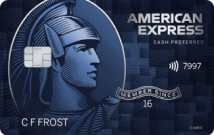

The Blue Cash Preferred® Credit Card from American Express is a premium everyday cash-back credit card designed for households that spend heavily at U.S. supermarkets, subscribe to eligible U.S. streaming services and regularly pay for gas or transit. Its headline rewards include 6% cash back at U.S. supermarkets on up to $6,000 in eligible purchases per calendar year and then 1%, unlimited 6% back on select U.S. streaming subscriptions, 3% back at eligible U.S. gas stations and on transit, and 1% on other qualifying purchases. American Express currently waives the $95 annual fee during the first year and offers personalized welcome bonuses potentially worth as much as $300 after meeting the spending requirement, along with a 12-month 0% introductory APR. The card can deliver excellent domestic household value, but its supermarket cap, foreign transaction fee and recurring annual cost mean applicants should compare expected rewards with no-fee alternatives before applying.
- 6% Cash Back at U.S. Supermarkets
- High Rewards on Streaming Services
- Strong Gas and Transit Rewards
- Introductory Annual Fee Waiver
- Simple Cash Back Redemption
- $95 Annual Fee After the First Year
- Grocery Rewards Have a Spending Limit
- Lower Rewards on General Purchases
- Spending Caps on Bonus Categories
- Foreign Transaction Fees
Favorable Details:
- 6% Cash Back at U.S. Supermarkets: Earn 6% cash back on eligible U.S. supermarket purchases (up to $6,000 annually, then 1%), making it one of the strongest grocery rewards cards available.
- High Rewards on Streaming Services: Earn 6% cash back on select U.S. streaming subscriptions, helping reduce the cost of popular entertainment services.
- Strong Gas and Transit Rewards: Earn 3% cash back at U.S. gas stations and on eligible transit purchases, including rideshare services, parking, tolls, trains, and buses.
- Introductory Annual Fee Waiver: New cardmembers receive a $0 introductory annual fee for the first year before the $95 annual fee applies.
- Simple Cash Back Redemption: Rewards are earned as Reward Dollars that can be redeemed for statement credits or eligible purchases.
Unfavorable Details:
- $95 Annual Fee After the First Year: The annual fee can reduce the card’s value for people who do not spend enough in bonus categories.
- Grocery Rewards Have a Spending Limit: The 6% supermarket cash back rate only applies to the first $6,000 in eligible annual purchases, then drops to 1%.
- Lower Rewards on General Purchases: Purchases outside bonus categories earn only 1% cash back, which is less competitive than some flat-rate cash back cards.
- Spending Caps on Bonus Categories: The 4X earning rates have annual spending limits before dropping to a lower rate.
- Foreign Transaction Fees: The card is not ideal for international travel because foreign purchases may include transaction fees.
Blue Cash Preferred® Card from American Express Quick Facts
| Feature | Details |
|---|---|
| Credit Card Issuer | American Express National Bank |
| Payment Network | American Express |
| Reward Type | Cash Back Rewards Credit Card |
| Recommended Credit Score | Good to Excellent Credit Score (690-850) |
| Annual Fee | $0 introductory annual fee for the first year, then $95 |
| Security Deposit | None |
| Standard Rewards | 1% cash back on other eligible purchases |
| Bonus Rewards | 6% at U.S. supermarkets on up to $6,000 per calendar year, then 1%; 6% on select U.S. streaming subscriptions; 3% at eligible U.S. gas stations and on transit |
| Welcome Bonus | Personalized offer as high as $300 cash back after $3,000 in purchases within six months; offers vary and some applicants may receive a lower offer or none |
| Intro APR | 0% introductory APR on purchases and eligible balance transfers for 12 months from account opening; transfers must generally be requested within the first 60 days |
| Regular APR | 19.49%–28.49% variable APR after the introductory period, based on creditworthiness and subject to change |
| Balance Transfer Fee | Either $5 or 3% of each transferred amount, whichever is greater |
| Cash Advance Fee | Either $10 or 5% of each cash advance, whichever is greater |
| Foreign Transaction Fees | 2.7% of each transaction after conversion to U.S. dollars |
| Credit Bureau Reporting | Account activity is generally reported to Equifax, Experian and TransUnion |
| Credit Line Increases | May be requested or offered after review; approval and the amount are not guaranteed |
| Best For | Households with substantial U.S. supermarket, streaming, gas and transit spending that can offset the annual fee |
| Employee Cards | Not applicable to this consumer card; Additional Card Members may be added subject to account terms |
6% Cash Back at U.S. Supermarkets
The Blue Cash Preferred Card’s defining feature is 6% cash back on the first $6,000 in eligible purchases made at U.S. supermarkets during each calendar year, followed by 1% after the cap is reached. A household that spends exactly $500 per month at qualifying supermarkets would reach the annual limit and earn $360 before considering the annual fee, making this one of the strongest fixed grocery rates available on a mainstream consumer card. American Express relies on merchant classifications, so superstores, warehouse clubs, convenience stores and meal-kit services generally do not count even when they sell groceries. Returns and credits reduce eligible spending, and purchases above the calendar-year cap earn only the base rate, making it important to track progress and move excess grocery spending to another card when appropriate.
How the Blue Cash Preferred Card Works
The Blue Cash Preferred Card is an unsecured revolving credit account with an assigned credit limit, monthly statements and a required minimum payment. Cardholders can make purchases up to their available credit, earn Reward Dollars on eligible transactions and restore available credit as payments post. The account permits a balance to be carried, but any amount not protected by an introductory offer or purchase grace period can accrue interest under the cardmember agreement. The primary cardholder is responsible for all charges, including transactions made by Additional Card Members, and must submit at least the minimum amount by the due date even when a reward redemption, merchant refund or dispute is pending. Paying the complete statement balance remains the best way to protect the financial value of the cash back.
$0 Introductory Annual Fee, Then $95
American Express charges no annual fee during the first year and $95 each year afterward, creating strong first-year value but requiring an ongoing break-even calculation. Compared with the no-annual-fee Blue Cash Everyday Card’s 3% supermarket rate, Blue Cash Preferred earns an additional 3 percentage points on qualifying groceries; approximately $3,167 of annual supermarket spending would generate $95 of extra rewards and offset the later annual fee before considering streaming, transit, gas or monthly credits. Spending the full $6,000 supermarket cap produces $360 at 6%, which is $180 more than a 3% grocery card and leaves an $85 advantage after the $95 fee. Actual value depends on alternative cards, category eligibility and whether the cardholder uses the additional benefits naturally.
No Security Deposit
The Blue Cash Preferred Card does not require a security deposit because it is an unsecured credit card intended primarily for applicants with good to excellent credit. American Express establishes the approved credit line through underwriting rather than holding the cardholder’s money as collateral, distinguishing the account from a secured card used for rebuilding or establishing credit. It is also different from a debit or prepaid card because purchases draw against borrowed credit and must be repaid according to the monthly statement. The absence of a deposit improves liquidity but does not make approval easy, and applicants with limited history, high utilization, recent delinquencies or insufficient income may need a no-fee starter or secured product before pursuing a rewards card with a recurring annual cost.
American Express Reward Dollars Program
Cash back is issued as Reward Dollars based on eligible net purchases during each billing period. The program pays 6 Reward Dollars for every $100 spent in qualifying supermarket or streaming categories, 3 Reward Dollars for every $100 at eligible U.S. gas stations or on transit and 1 Reward Dollar per $100 on other purchases. Reward Dollars provide straightforward cash value and can be redeemed as a statement credit or used at eligible Amazon checkout transactions, rather than transferred to airline or hotel loyalty programs. Fees, interest, balance transfers, cash advances, person-to-person payments, prepaid-card loads, gift cards and other cash-equivalent transactions are generally excluded. The program is best for consumers who prefer predictable household cash back over the potentially complex but sometimes higher-value travel-redemption opportunities of points cards.
6% Streaming Rewards and the $120 Disney Streaming Credit
Select U.S. streaming subscriptions earn 6% cash back, and an enrolled card account can also receive up to $10 in monthly statement credits—up to $120 per calendar year—after eligible subscription purchases through qualifying U.S. Disney+, Hulu or ESPN channels. A household paying $30 per month to eligible streaming providers could earn about $21.60 in annual cash back before considering the monthly credit, while full use of the credit could separately offset as much as $120 of qualifying charges. Enrollment is required, subscriptions generally renew automatically and third-party billing arrangements may not qualify, so cardholders should confirm how the provider processes the payment. The benefit should be valued only when the household already wants the subscription, because starting an unnecessary service solely to receive a statement credit does not create savings.
3% Cash Back on U.S. Gas Stations and Transit
The card earns 3% cash back at eligible U.S. gas stations and on qualifying transit, including many taxis, rideshare services, parking facilities, tolls, trains, buses and ferries. A commuter spending $250 per month across gasoline, parking and transit could earn approximately $90 per year, compared with $30 at the 1% base rate. The categories are defined by merchant codes, which means fuel purchased from a warehouse club, supermarket or superstore may not qualify as a U.S. gas-station transaction, while transportation expenses outside the published transit definition may earn only 1%. Unlike the supermarket category, American Express does not currently publish a general annual cap for the 3% gas and transit rates, although rewards terms and merchant eligibility can change.
No Rotating Reward Categories
Blue Cash Preferred does not use quarterly category activation, and its supermarket, streaming, gas and transit rates remain consistent throughout the year under the current program. This structure makes budgeting and card selection easier than a rotating-category product because cardholders do not need to register every three months or follow a changing merchant calendar. The supermarket bonus still has a $6,000 calendar-year limit, so the card is not entirely free of tracking, and the fixed categories may miss spending areas such as dining, drugstores, travel and general online shopping. Consumers willing to manage several cards can pair Blue Cash Preferred with a flat 2% card or another category card, while those seeking one-card simplicity should evaluate whether the weak 1% base rate is acceptable.
Rewards Limits
The 6% supermarket rate is capped at $6,000 in eligible calendar-year spending and then falls to 1%, while the 6% streaming and 3% gas and transit categories do not currently carry the same published general spending cap. All earnings apply to net eligible purchases, so refunds, returns and credits can reduce Reward Dollars, and American Express can withhold or reverse rewards associated with abuse, fraud or account misuse. Balance transfers, cash advances, fees, interest, cash equivalents and purchases covered by Reward Dollars at checkout generally do not earn cash back. The credit line also limits purchasing capacity, and cardholders should never accelerate grocery or streaming spending simply to maximize a rate; unnecessary consumption costs far more than the rewards it produces.
Redeeming Rewards
Reward Dollars can be applied as a statement credit through the American Express account or used at eligible Amazon checkout transactions at the same stated value. A statement credit lowers the outstanding account balance but does not satisfy the minimum payment, so cardholders must still make the required payment shown on the statement by its due date. Unlike transferable Membership Rewards points, Reward Dollars cannot be moved to airline or hotel partners for potentially outsized travel value, which makes the program simpler but less flexible for award travelers. Cardholders should redeem through the option that provides full value, monitor any current eligibility or minimum rules displayed in the account and avoid using rewards at checkout if doing so encourages purchases that would not otherwise be made.
Rewards Expiration
Reward Dollars generally do not expire while the Blue Cash Preferred account remains open and in good standing, allowing cardholders to redeem frequently or accumulate a larger balance. Rewards can still be forfeited or become unavailable if the account is closed, becomes seriously delinquent or is involved in misuse under the rewards terms. Before canceling the card to avoid a new annual fee, a cardholder should redeem the available Reward Dollars and consider whether a permitted product change could preserve the account relationship, although any conversion is subject to American Express approval and current options. Rewards are not a deposit account and should not be treated as protected cash until redeemed, making periodic redemptions a sensible way to reduce forfeiture risk.
Welcome Bonus
The current application process may provide a personalized welcome offer as high as $300 cash back after $3,000 in qualifying purchases within the first six months of card membership, but offer amounts vary and some applicants may receive a lower amount or no bonus. An approved applicant can generally see the specific offer before choosing whether to accept the card, which improves transparency compared with a single universal bonus. The spending requirement averages $500 per month for six months and should be met only through planned household expenses that can be repaid without interest. American Express may restrict bonus eligibility based on previous card ownership, earlier welcome offers, account history or other factors disclosed during application, and the precise personalized offer controls the account.
Introductory APR
The card currently provides 0% introductory APR on purchases and eligible balance transfers for 12 months from account opening, with balance transfers generally needing to be requested within the first 60 days and subject to a fee of at least $5 or 3% of the transferred amount. The promotion can reduce financing costs on a planned purchase or qualifying debt transfer, but it does not eliminate the balance or the obligation to make monthly minimum payments. A $6,000 balance would require average principal payments of about $500 per month to be cleared within 12 months, excluding the transfer fee. Any unpaid promotional balance becomes subject to the standard variable APR after the period ends, so cardholders should create a payoff schedule immediately rather than waiting until the final months.
Variable Purchase APR
After the introductory period, the Blue Cash Preferred Card carries a 19.49%–28.49% variable APR, with the approved rate determined by creditworthiness and future movement tied to the applicable benchmark and account terms. Carrying debt at these rates can overwhelm even 6% cash back; a cardholder who earns $60 on $1,000 of supermarket purchases can lose that value quickly if the balance remains unpaid for several months. Cash advances are more expensive because they can carry a separate rate, begin accruing interest immediately and include a fee of at least $10 or 5%. The card is most rewarding when used as a payment method for budgeted expenses, not as a long-term loan, and the standard APR should remain a major consideration even when the first-year promotional rate is 0%.
Paying the Balance in Full
Paying the full statement balance by the due date generally avoids interest on eligible purchases when the grace-period conditions apply and keeps the card’s cash back economically meaningful. AutoPay can reduce the risk of forgetting a deadline, but cardholders should confirm that the linked bank account has enough funds and review the statement for errors before the withdrawal. During the 0% introductory period, paying only the minimum may preserve the promotional rate while allowing an unaffordable balance to build, so a separate monthly amount based on full repayment within 12 months is more responsible. Reward redemptions, returns and monthly streaming credits lower the balance but do not replace the required payment or justify adding purchases that exceed the household budget.
Building Credit With the Blue Cash Preferred Card
Responsible management of the Blue Cash Preferred Card may support a strong credit profile by adding on-time payment history, revolving credit capacity and account age to a consumer’s reports. The most important practices are paying every bill by the deadline, keeping balances low relative to the limit, using the introductory APR according to a written payoff plan and avoiding unnecessary new applications. The annual fee means the card should not be opened solely to build credit when lower-cost products can report the same basic account information. Credit scores depend on the complete report and the model used, and opening the account may initially create an inquiry and reduce average account age, so neither American Express nor any reviewer can guarantee a particular score increase.
Reports to the Major Credit Bureaus
American Express generally reports consumer credit-card activity to Equifax, Experian and TransUnion, allowing the account’s balance, limit, age and payment status to become part of the cardholder’s credit history. Timely payments and controlled utilization can support responsible-credit signals over time, while missed payments, high balances, default or charge-off can harm creditworthiness and remain visible for years. Reporting usually occurs on a periodic schedule, so a balance may appear on a credit report even if it is later paid by the statement due date. Cardholders should check their reports regularly, dispute genuine inaccuracies through the proper process and contact American Express promptly when an account or payment issue might affect reported information.
Keeping Credit Utilization Low
Credit utilization compares reported revolving balances with available credit limits and can influence credit scores independently of whether interest is paid. A $2,000 reported balance on a Blue Cash Preferred account with a $5,000 limit represents 40% utilization, while reducing the reported balance to $500 lowers the ratio to 10%. No utilization percentage guarantees a particular score, but lower balances generally indicate less revolving-credit risk than accounts close to their limits. Cardholders can make an extra payment before the statement closes, set balance alerts, divide large planned expenses across billing cycles and avoid using the 0% offer as permission to approach the limit, while still making at least the required payment by every due date.
Credit Line Increases
American Express may offer or allow a request for a higher credit line after reviewing the account and the cardholder’s broader creditworthiness, but approval, timing and amount are never guaranteed. Factors can include income, employment, payment history, current balance, account age, spending patterns, reported debt and recent credit activity. A larger limit may reduce utilization when spending stays unchanged and can provide more flexibility for household expenses, but it should not be treated as new income or a reason to carry debt. Before requesting an increase, cardholders should update financial information accurately, confirm whether the review could affect credit and assess whether a higher limit supports a practical need rather than additional discretionary spending.
Good-to-Excellent-Credit Applicants
The Blue Cash Preferred Card is best suited to applicants with good to excellent credit, a dependable payment record and enough income to manage the account and annual fee. A competitive score can strengthen an application, but American Express may also consider existing debt, utilization, income, housing expenses, recent inquiries, account history and prior relationships with the issuer. Consumers with thin files, recent delinquencies, heavy revolving balances or multiple new accounts may have weaker approval prospects even if one score appears within a commonly recommended range. The issuer’s decision process allows many applicants to learn whether they are approved before accepting the card, but approval and the assigned credit line still depend on accurate application data and the full underwriting review.
Applying for the Blue Cash Preferred Card
Applicants typically provide a legal name, residential address, Social Security number, date of birth, contact information, employment status, annual income and other financial details requested by American Express. The issuer can approve the application, decline it or request verification, and an eligible approved applicant may receive an instant card number for certain digital purchases. The application flow generally shows approval and the personalized welcome offer before the applicant chooses whether to accept; once accepted, information provided to credit bureaus may affect the applicant’s credit score. Before accepting, the consumer should verify the exact bonus, $0 first-year fee, later $95 annual fee, APR, balance-transfer deadline, spending categories and benefit terms displayed in the offer.
Checking Eligibility Before Applying
American Express states that applicants can find out whether they are approved without an initial impact to their credit score, and only choosing to accept the approved card may lead to information being provided to the credit bureaus and a possible score impact. This process can help consumers evaluate approval and a personalized welcome offer without committing immediately. It does not make every application risk-free indefinitely, guarantee a credit limit or ensure the applicant receives the maximum advertised bonus. Consumers should still apply selectively, enter accurate information and review the disclosed terms before accepting. A positive decision also does not prove that the card fits the household budget, so the reward structure and recurring annual fee should be evaluated independently from approval.
Consumers Building Credit
Blue Cash Preferred can report positive activity when used responsibly, but it is not an ideal first credit-building card for consumers with limited history because approval commonly favors good to excellent credit and the $95 annual fee begins after the first year. A no-annual-fee starter or secured card can provide the same opportunity to establish payment history with lower qualification barriers and no recurring membership cost. A consumer who already has some credit history and receives approval can use Blue Cash Preferred for a few predictable household bills, keep utilization controlled and pay in full. Rewards should remain secondary to avoiding interest and late payments, since negative account activity can cause far more damage than the grocery cash back can repair.
Consumers Rebuilding Credit
The card is generally not appropriate for active credit rebuilding because recent delinquencies, charge-offs, high utilization or bankruptcy may conflict with its good-to-excellent-credit positioning. If a rebuilding consumer is approved, consistent payments and lower balances may contribute positive recent history, but the card cannot remove accurate negative information or guarantee improvement. A secured card or a transparent no-fee product designed for fair credit may offer a more realistic approval path and lower financial pressure. Consumers should first stabilize past-due accounts, reduce revolving balances, check reports for errors and avoid repeated applications, then consider Blue Cash Preferred when both the credit profile and household spending are strong enough to justify its annual fee.
First-Time Cash-Back Credit Card Users
Blue Cash Preferred is manageable for a first-time cash-back user because its categories do not rotate and Reward Dollars have straightforward statement-credit value. The card still requires more attention than a flat-rate product because the user must recognize eligible U.S. supermarkets, track the $6,000 calendar-year cap, enroll in the Disney Streaming Credit and direct nonbonus purchases elsewhere when maximizing rewards. Beginners should automate at least the minimum payment, aim to pay every statement in full and treat the 0% period as a fixed repayment window rather than free money. A consumer with modest grocery spending or a preference for one uncomplicated card may find a no-fee 2% card or Blue Cash Everyday easier to maintain.
Students and Young Adults
Blue Cash Preferred can be useful for a young adult managing a large household grocery budget, multiple eligible streaming subscriptions and commuting expenses, but it is usually not the best first card for a student with limited credit and income. The $95 annual fee after year one requires enough category spending to remain worthwhile, and supermarket purchases at campus convenience stores or superstores may not qualify for 6%. Students may receive better value from a no-annual-fee student card, a secured card or Blue Cash Everyday if they qualify. A young professional with good credit, predictable grocery costs and the ability to pay in full may justify Blue Cash Preferred, especially when the introductory fee waiver and personalized welcome offer are used through planned spending.
International Purchases
The Blue Cash Preferred Card charges a 2.7% foreign transaction fee on each international transaction after conversion to U.S. dollars, making it a poor primary card for travel abroad or purchases from overseas merchants. The bonus categories are also centered on U.S. supermarkets, U.S. gas stations and U.S. streaming providers, so foreign spending is likely to earn only 1% before the fee, creating a negative net return. American Express acceptance has expanded but can still be less consistent than Visa or Mastercard in some countries and small businesses. Travelers should use a widely accepted card with no foreign transaction fee for most international purchases, carry a backup payment method and reserve Blue Cash Preferred for its stronger domestic categories.
Digital Account Management
The American Express website and mobile app allow cardholders to monitor transactions, view Reward Dollars, make payments, set up AutoPay, activate Amex Offers, manage alerts, review benefits and add eligible cards to digital wallets. Qualified new cardholders may receive an instant card number, while Plan It can divide eligible purchases of $100 or more into installment plans with a fixed fee when available. Send & Split provides additional payment functionality through supported services after enrollment. These tools can simplify household management, but cardholders must still confirm payment completion, read monthly statements and evaluate plan fees before using installment features. Real-time notifications are helpful for identifying unusual activity but do not replace regular account review.
Security and Fraud Monitoring
American Express provides fraud monitoring, transaction alerts, account controls and assistance with unauthorized or incorrect charges, while eligible purchases may receive purchase protection, return protection and extended warranty coverage subject to detailed limitations. Cardholders should report a lost card or suspicious transaction immediately, protect login credentials and use multifactor authentication when available. Fraud protections generally require investigation and do not cover every scam, authorized payment or purchase made by someone voluntarily given access to the account. Additional Card Members should understand that the primary cardholder remains responsible for their activity. Security benefits are strongest when combined with regular statement review, unique passwords, secure devices and prompt communication through trusted American Express contact channels.
Blue Cash Preferred® Card from American Express vs. Blue Cash Everyday® Card
Blue Cash Preferred offers 6% at U.S. supermarkets on up to $6,000 per year, 6% on select U.S. streaming and 3% on transit, while Blue Cash Everyday charges no annual fee and earns 3% at U.S. supermarkets, U.S. gas stations and U.S. online retailers on up to $6,000 annually in each category, followed by 1%. Both cards offer American Express Reward Dollars, a foreign transaction fee and versions of a Disney streaming credit, but Preferred’s monthly credit is currently higher. After the first-year fee waiver, roughly $3,167 of qualifying supermarket spending can offset Preferred’s $95 fee through the 3-percentage-point grocery advantage alone. Preferred suits larger grocery and streaming budgets; Everyday is better for fee-sensitive or online-retail-focused consumers.
Blue Cash Preferred® Card from American Express vs. Capital One Savor Rewards
Capital One Savor Rewards charges no annual fee and earns 3% cash back at qualifying grocery stores and on dining, entertainment and popular streaming services, plus elevated rewards on eligible Capital One Entertainment and Travel purchases. Blue Cash Preferred doubles the grocery and select streaming rate to 6%, adds 3% on transit and U.S. gas stations and offers a larger monthly Disney streaming credit, but it caps the supermarket rate, charges $95 after year one and imposes a 2.7% foreign transaction fee. Savor is stronger for dining, entertainment, international purchases and households that dislike annual fees, while Blue Cash Preferred can generate more value for domestic consumers who spend heavily at eligible U.S. supermarkets and use its streaming benefits.
Blue Cash Preferred® Card from American Express vs. Citi Custom Cash® Card
Citi Custom Cash charges no annual fee and automatically earns 5% cash back in the cardholder’s top eligible category each billing cycle on up to $500 of spending, followed by 1%, with grocery stores, gas, transit, streaming and restaurants among the eligible categories. Blue Cash Preferred earns a higher 6% rate at U.S. supermarkets and on select U.S. streaming, allows separate 3% gas and transit earnings and adds the Disney credit, but its $95 annual fee begins after year one. Custom Cash is well suited to concentrating one spending category each month, while Blue Cash Preferred supports several household categories simultaneously. Consumers should compare the monthly $500 Citi cap with the annual $6,000 Amex supermarket cap and consider which merchant definitions match their spending.
Blue Cash Preferred® Card from American Express vs. Traditional Cash-Back Cards
Traditional cash-back cards often charge no annual fee and earn a flat 1.5% or 2% on every purchase, while category cards may pay 3% to 5% on selected spending with caps or activation requirements. Blue Cash Preferred accepts a $95 recurring fee in exchange for an unusually high 6% supermarket and streaming rate, supported by 3% gas and transit categories and a monthly subscription credit. Its domestic household rewards can outperform flat-rate cards, but the 1% base rate, supermarket cap and foreign transaction fee create important weaknesses. It is best used as a category specialist alongside a stronger general-purchase card, whereas a consumer seeking one uncomplicated account may receive steadier overall value from an unlimited 2% card.
Is the Blue Cash Preferred® Card from American Express Good for Good to Excellent Credit?
Blue Cash Preferred is a strong choice for a good-to-excellent-credit applicant whose domestic household spending aligns with the bonus categories and whose budget supports paying in full. The rewards, first-year fee waiver, personalized bonus, introductory APR and shopping protections create a competitive package, but strong-credit consumers also qualify for many no-fee and travel-oriented alternatives. Approval alone should not determine the decision; the applicant should calculate expected supermarket, streaming, gas and transit rewards, subtract the second-year annual fee and compare the result with other cards. The card is particularly compelling for families near the $6,000 supermarket cap, while light grocery spenders may receive better long-term value elsewhere.
Is the Blue Cash Preferred® Card from American Express Good for Beginners?
The card can be good for a financially disciplined beginner who already has sufficient credit history, spends predictably in its categories and is comfortable tracking the annual supermarket cap. Its Reward Dollars are easier to understand than transferable travel points, and the fixed categories require no quarterly activation. The main beginner risks are using the 0% period to build debt, forgetting that the $95 fee begins in year two and putting too much uncategorized spending on the 1% base rate. A beginner should establish AutoPay, create a payoff schedule for any promotional balance, enroll only in benefits already needed and review value before the first renewal. A no-fee flat-rate card remains simpler for many first-time users.
Is the Blue Cash Preferred® Card from American Express Good for Rebuilding Credit?
Blue Cash Preferred is generally not a good rebuilding card because it commonly requires good to excellent credit and adds an annual fee after the first year rather than offering features specifically designed for damaged credit. Responsible use could support recent positive payment history if a rebuilding consumer were approved, but the account would not remove prior negative items or guarantee a score increase. A secured or fair-credit card with low transparent fees is typically a more appropriate starting point, followed by Blue Cash Preferred after utilization, payment history and overall finances have improved. Applying prematurely can add an inquiry without producing approval, so consumers should use American Express’s approval process selectively and consider more accessible alternatives first.
Is the Blue Cash Preferred® Card from American Express Worth It?
Blue Cash Preferred is worth it for households that can earn more than $95 of incremental annual value after the first-year waiver. Relative to Blue Cash Everyday’s 3% supermarket rate, spending about $3,167 at qualifying supermarkets offsets the $95 fee through the additional 3% alone; spending the full $6,000 produces $180 more grocery rewards and an $85 net advantage after the fee. Eligible streaming at 6%, gas and transit at 3% and up to $120 in monthly Disney credits can widen the margin, but only when those purchases already fit the budget. The card is less worthwhile for shoppers who use warehouse clubs or superstores, spend little on groceries, travel internationally or prefer a single unlimited flat-rate card.
Credit Requirements
Applicants should generally have a good to excellent credit profile, although American Express does not publish a score that guarantees approval. Underwriting can consider payment history, revolving utilization, account age, income, housing expenses, total debt, recent applications, identity information and prior American Express relationships. A high score may not overcome excessive obligations or recent negative events, while an applicant outside a commonly recommended range may still be approved based on the complete file. The application can show an approval decision before the consumer accepts the card, but the specific credit line, APR and welcome offer depend on the individual review. Applicants should enter accurate income information and select the card based on affordability rather than approval status alone.
Credit-Building Strategy
A disciplined strategy is to use Blue Cash Preferred for planned supermarket, streaming, gas and transit expenses, track progress toward the grocery cap and pay the statement balance in full each month. Balance alerts and an extra payment before the statement closes can help control reported utilization, while AutoPay for at least the minimum reduces late-payment risk. Anyone using the introductory APR should divide the financed amount and transfer fee by the remaining promotional months and schedule payments large enough to reach a zero balance before standard interest begins. Cardholders should review all three credit reports periodically, limit unnecessary applications and update their household-value calculation before each annual renewal, recognizing that responsible use may help but cannot guarantee a particular credit outcome.
Avoiding Excessive Debt
Six percent cash back does not justify buying more groceries, subscriptions or transportation than the household needs, because the remaining 94% of every qualifying purchase still comes out of the budget. Interest at the standard variable APR can eliminate months of rewards, and the 0% introductory period can create a false sense of affordability if the balance is not divided into scheduled payments. Cardholders should maintain a purchase budget, subtract charges from available cash, avoid cash advances and stop new spending when repayment becomes uncertain. The welcome-bonus requirement should be reached through expenses that would occur anyway, and any growing balance should shift the priority from earning rewards to paying down debt as efficiently as possible.
Long-Term Value
The card’s long-term value depends on maintaining enough eligible supermarket and streaming spending to justify the $95 fee after the first year while continuing to use the gas, transit and Disney benefits. Households should total actual annual Reward Dollars and statement credits, subtract the fee and compare the result with Blue Cash Everyday, a 2% flat-rate card or another category product. Changes in family size, grocery stores, commuting patterns and subscription use can alter the calculation, as can updates to card terms. Before canceling, the cardholder should redeem Reward Dollars, consider utilization and account age and ask whether a no-fee product change is available, understanding that American Express is not required to offer or approve a conversion.
Final Verdict
The Blue Cash Preferred® Card from American Express is one of the strongest domestic household cash-back cards for consumers who regularly shop at eligible U.S. supermarkets and pay for select streaming subscriptions. Its 6% grocery and streaming rates, 3% gas and transit earnings, $120 Disney Streaming Credit, first-year annual-fee waiver, personalized welcome offer and 12-month introductory APR can produce substantial value when used carefully. The main limitations are the $95 annual fee after year one, $6,000 supermarket cap, 1% base rate, category exclusions and 2.7% foreign transaction fee. For a cardholder with good to excellent credit who spends at least roughly $3,200 per year at qualifying supermarkets, uses the streaming benefits and pays balances responsibly, Blue Cash Preferred can be an excellent long-term choice; light grocery shoppers, international travelers and consumers rebuilding credit should generally choose a lower-cost alternative.