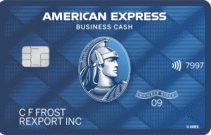

The American Express® Blue Business Cash™ Credit Card is a no-annual-fee business credit card designed for small-business owners who want straightforward cash-back rewards, introductory purchase financing and useful expense-management features without tracking rotating categories. The card earns 2% cash back on the first $50,000 in eligible purchases each calendar year and 1% thereafter, with rewards automatically applied as statement credits. Eligible new cardholders can also earn a $250 statement credit after spending $3,000 on qualifying purchases within the first three months, while a 0% introductory purchase APR for 12 months can help finance planned business expenses. Its primary disadvantages are the $50,000 limit on the 2% rate, a 2.7% foreign transaction fee and a potentially expensive variable APR after the introductory period. Overall, the Blue Business Cash Card is best suited to U.S.-focused small businesses that spend no more than approximately $50,000 annually, prefer automatic cash back and can pay the account responsibly.
- No Annual Fee
- Simple Cash Back Structure
- Automatic Redemptions
- Intro APR on Purchases
- Fraud Protection
- $50,000 Spending Cap
- Foreign Transaction Fee
- No Points Transfer Options
- Not Ideal for International Use
- Spending Optimization Needed
Favorable Details:
- No Annual Fee: Business owners can keep the account without paying a yearly ownership charge, making it easier to preserve the value of the rewards.
- Strong Flat Cash-Back Rate: The card earns 2% cash back on the first $50,000 in eligible purchases each calendar year.
- Automatic Statement Credits: Earned cash back is automatically credited to the account, eliminating manual reward redemption.
- Attainable Welcome Offer: Eligible new cardholders can earn a $250 statement credit after completing the required $3,000 of qualifying purchases within three months.
- Introductory Purchase Financing: A 0% introductory APR applies to purchases for the first 12 months after account opening.
- Expanded Buying Power: Eligible cardholders may be permitted to spend above the stated credit limit when American Express approves the additional purchasing capacity.
- Employee Cards: Employee Blue Business Cash Cards are available with no annual fee and can help centralize company spending.
- Business Management Benefits: Digital statements, spending alerts, account-manager access, year-end summaries and QuickBooks connectivity can simplify expense administration.
Unfavorable Details:
- $50,000 Rewards Threshold: The cash-back rate falls from 2% to 1% after the account reaches $50,000 in eligible calendar-year purchases.
- Foreign Transaction Fee: International purchases are subject to a 2.7% fee after conversion to U.S. dollars.
- No Transferable Rewards: Cash back cannot be transferred to airline or hotel loyalty programs for potentially higher travel value.
- Potentially High Ongoing APR: After the introductory period, the variable purchase APR can make carrying a balance expensive.
- Limited Premium Benefits: The card does not provide airport lounge membership, annual travel credits or the extensive protections associated with premium business cards.
- American Express Acceptance: Although acceptance is extensive in the United States, some domestic and international merchants may not accept the American Express network.
American Express® Blue Business Cash™ Card Quick Facts
| Feature | Details |
|---|---|
| Credit Card Issuer | American Express National Bank |
| Payment Network | American Express |
| Reward Type | Cash Back Rewards Credit Card |
| Recommended Credit Score | Good to Excellent Credit Score (690-850) |
| Annual Fee | $0 |
| Security Deposit | None |
| Standard Rewards | 2% cash back on the first $50,000 in eligible calendar-year purchases, then 1% |
| Bonus Rewards | No permanent category-specific bonus rate; eligible Amex Offers may provide additional value |
| Welcome Bonus | $250 statement credit after $3,000 in eligible purchases within the first three months |
| Intro APR | 0% introductory APR on purchases for the first 12 months |
| Regular APR | 16.74% to 28.49% variable after the introductory period |
| Balance Transfer Fee | If eligible, $5 or 3% of each transfer, whichever is greater |
| Cash Advance Fee | Availability and applicable cost should be confirmed in the Card Member Agreement |
| Foreign Transaction Fees | 2.7% of each transaction after conversion to U.S. dollars |
| Credit Bureau Reporting | Business and consumer reporting practices apply; serious negative activity may affect personal credit |
| Credit Line Increases | May be available based on account history and creditworthiness but are not guaranteed |
| Best For | Small businesses seeking no-annual-fee, flat-rate cash back on up to $50,000 in annual spending |
| Employee Cards | No annual fee; up to 99 total Employee Cards may be added, subject to account terms |
2% Cash Back on Eligible Business Purchases
The primary attraction of the American Express Blue Business Cash Card is its 2% cash-back rate on the first $50,000 in eligible purchases during each calendar year, after which eligible purchases earn 1% until the next calendar year begins. A business that charges exactly $50,000 in qualifying expenses could earn $1,000 in annual cash back, while $60,000 of spending would earn $1,100 because the first $50,000 receives $1,000 and the remaining $10,000 earns $100. The rate applies across ordinary eligible purchases rather than selected business categories, making the card useful for inventory, advertising, office supplies, software, utilities, professional services and other expenses that might not qualify for elevated rewards elsewhere. Fees, interest, gift cards, person-to-person payments, prepaid-card reloads, cash equivalents and returned purchases generally do not earn cash back.
How the American Express Blue Business Cash Card Works
The Blue Business Cash Card operates as a revolving business credit card with a defined credit limit, monthly billing statements, a minimum payment requirement and the option to carry eligible balances subject to the applicable APR. The business and authorizing officer are responsible for all charges, including purchases made by Employee Card Members, and the applicant agrees that the account will be used for commercial or business purposes. Available credit normally decreases as transactions post and increases after payments are processed, although timing can vary. Expanded Buying Power may permit qualifying purchases above the stated credit limit, but this capacity is not unlimited and can change based on payment history, account use, credit records, financial resources and other factors. Any amount charged above the regular limit may become part of the minimum payment and require faster repayment than an ordinary revolving balance.
$0 Annual Fee
The American Express Blue Business Cash Card charges a $0 annual fee, allowing a qualifying business to retain the account without earning a specific amount of cash back merely to recover an annual ownership cost. This feature makes the card accessible to freelancers, sole proprietors, startups and established small businesses with modest spending, and it also allows the account to remain useful during a slow year when expenses decline. Because there is no annual fee, even $10,000 in qualifying purchases at the 2% rate could produce approximately $200 in gross annual cash back without a yearly charge reducing that return. Cardholders can still incur interest, foreign transaction fees, balance-transfer fees, late fees or returned-payment fees, so no annual fee should not be interpreted as meaning the account is completely free under every pattern of use.
No Security Deposit
The Blue Business Cash Card is an unsecured business credit card, which means an approved applicant does not have to provide a refundable security deposit to establish the account. Approval and the initial credit limit are determined through underwriting that may consider the applicant’s personal credit, business information, income, revenue, existing debt, payment history and relationship with American Express. Unlike a secured business card, the account does not require cash collateral equal to some or all of its limit, and unlike a debit or prepaid card, purchases are financed through a credit account that must be repaid. The absence of a deposit preserves business cash flow, but it also means applicants with damaged or very limited credit may find approval more difficult than they would with a secured product specifically designed for credit establishment.
Cash-Back Rewards Program
Cash back earned with the American Express Blue Business Cash Card is calculated as a percentage of eligible purchases and automatically issued as a statement credit, providing a simple way to reduce the account balance. The first $50,000 in qualifying calendar-year purchases earns 2%, and spending above that amount earns 1% through December 31 before the higher-rate threshold resets for the next calendar year. Because the rewards are automatic, business owners do not need to accumulate points, select travel partners or request a check. However, a statement credit generally reduces the balance rather than satisfying the required minimum payment, so the cardholder must still make the payment shown on the billing statement. Returns, refunds and other merchant credits can reduce the eligible purchase amount and may cause previously calculated rewards to be reversed or adjusted.
Expanded Buying Power
Expanded Buying Power can allow an eligible Blue Business Cash Card account to complete purchases above its established credit limit, which may be useful when a business faces a larger-than-normal inventory order, equipment expense or short-term operating need. The additional amount is flexible and is evaluated using factors such as account activity, payment history, credit record, financial information known to American Express and the size of the attempted transaction. It should not be treated as an unlimited credit line or guaranteed source of emergency funding because a purchase above the limit may still be declined. The portion of a balance above the standard limit can also be included in the minimum payment and may need to be paid in full, making careful cash-flow planning essential before relying on this feature for a major business purchase.
Employee Cards and Expense Management
Business owners can add Employee Blue Business Cash Cards without an annual fee, earn cash back from qualifying employee purchases and review company expenses through a centralized account. American Express allows up to 99 total Employee Cards, subject to account approval and applicable terms, and the primary account holder remains responsible for every authorized charge. Owners may establish employee spending controls, receive transaction alerts and use summary reports to understand who is spending company funds and where those purchases occur. Additional tools can include online statements, downloadable transaction records, year-end summaries, account-manager permissions and connectivity with eligible QuickBooks Online accounts. These features can simplify bookkeeping and expense oversight, but they do not replace written company policies, receipt documentation, regular reconciliation or the prompt removal of card access when an employee’s responsibilities change.
No Rotating Reward Categories
The American Express Blue Business Cash Card does not require quarterly activation or the tracking of rotating merchant categories because its primary cash-back structure applies uniformly to eligible purchases. This simplicity benefits a business with varied expenses that do not consistently fall into categories such as office supplies, telecommunications, travel or advertising. Owners can use the card for ordinary qualifying purchases and know that the first $50,000 of calendar-year spending generally earns 2%, regardless of whether the expense occurs in January or December. The tradeoff is that the card does not regularly earn 3%, 4% or 5% in specialized categories, so a company with concentrated spending may earn more from a category-focused business card. Occasional targeted Amex Offers can add value, but availability, enrollment requirements, participating merchants and expiration dates vary by account.
Rewards Limits
The 2% cash-back rate is limited to the first $50,000 in eligible purchases per calendar year, creating a maximum of $1,000 in cash back at that rate before earnings decline to 1%. The lower rate continues on eligible purchases for the remainder of the calendar year, so rewards do not stop completely after the threshold is reached. A company spending $100,000 evenly on the card would earn approximately $1,500: $1,000 on the first $50,000 and $500 on the next $50,000. That produces an effective overall return of 1.5%, which may be less competitive than an unlimited 2% business card. Transactions involving fees, interest, cash equivalents, gift cards, person-to-person payments, prepaid-card funding and returned merchandise generally do not qualify, and cash back may be forfeited if the account is canceled or in default before a credit is issued.
Redeeming Cash Back
The Blue Business Cash Card automatically applies earned cash back as a statement credit, normally eliminating the need to sign in, request a redemption or meet a manual redemption minimum. Rewards calculated from eligible purchases may appear by the second billing statement following the statement on which those purchases appeared. This automated process is convenient for owners who want predictable savings rather than travel rewards, but it offers less flexibility than programs that permit redemptions for checks, bank deposits, travel reservations, gift cards or transfers to airline and hotel partners. The statement credit reduces the account balance but does not ordinarily replace the required minimum payment, so the cardholder should continue paying the amount due by the deadline. The account must also remain eligible and in good standing for the statement credit to be issued.
Cash-Back Expiration
Because cash back is automatically credited to the Blue Business Cash Card account, cardholders generally do not maintain a separate reward balance that must be redeemed before a conventional expiration date. Nevertheless, rewards can still be lost if the account is canceled, closed or in default before the applicable statement credit is issued. A business planning to close the account should allow pending transactions, returns and statement credits to finish processing and should verify that all expected rewards have appeared. American Express may also adjust or reverse cash back when a qualifying purchase is returned, refunded or determined to be ineligible. Reward rules and account benefits can change, so cardholders should review current program terms before making decisions based on expected cash back or closing an account with recent purchases still awaiting credits.
Welcome Bonus
Eligible new cardholders can earn a $250 statement credit after charging at least $3,000 in qualifying purchases within the first three months after account opening. The spending requirement represents an effective bonus return of approximately 8.33% on the required $3,000 before including the card’s normal cash back, although only purchases that the business already needs should be used to reach the threshold. Fees, interest, gift cards, prepaid-card reloads, person-to-person payments, cash equivalents and returned purchases do not qualify. American Express may restrict eligibility based on whether the applicant has had this card or an earlier version, the applicant’s American Express history, balance-transfer activity and the number of accounts opened or closed. The statement credit can take eight to twelve weeks after qualifying activity, and the account generally must remain open and not past due.
Introductory APR
The Blue Business Cash Card currently provides a 0% introductory APR on purchases for the first 12 months after account opening, which can help a business finance planned equipment, inventory, advertising or startup costs without promotional purchase interest. The offer does not eliminate the monthly minimum payment, and a late or returned payment can cause the introductory rate to end and a penalty APR to apply. Balance transfers may be available to eligible accounts, but the published 0% offer applies to purchases rather than balance transfers, and an eligible transfer carries a fee of either $5 or 3% of the transferred amount, whichever is greater. A business using the promotion should divide the financed balance by the remaining promotional months and complete repayment before the regular variable APR begins instead of treating the offer as permission to take on unaffordable debt.
Variable Purchase APR
After the 12-month introductory purchase period, the Blue Business Cash Card currently applies a variable purchase APR of 16.74% to 28.49%, with the rate determined by creditworthiness and other underwriting factors when the account is opened. Because the APR is linked to the prime rate, it can change as market rates move, and the applicable rate shown in the final account disclosure controls. A 2% cash-back reward cannot compensate for extended interest charges at these rates; for example, carrying a $5,000 balance at an APR near 25% could generate far more than $100 in annual interest, even though the original purchases earned approximately $100 in cash back. A penalty APR of up to 29.99% may apply after qualifying payment problems, making on-time payments and full repayment especially important.
Paying the Balance in Full
Paying the full statement balance by the due date is generally the best way to protect the value of the Blue Business Cash Card’s rewards and avoid purchase interest when the grace-period conditions apply. A company that earns $600 in annual cash back but pays $900 in interest has received a negative financial return despite the visible rewards. During the 0% introductory period, paying only the minimum may avoid promotional purchase interest temporarily, but it can leave a large balance exposed to the regular variable APR when the offer expires. Automatic payment of at least the minimum can reduce late-payment risk, while a separate scheduled payment based on a written payoff plan can eliminate the financed balance. The business should also maintain cash reserves instead of depending entirely on available credit for payroll, taxes or recurring operating expenses.
Building Credit With the Blue Business Cash Card
Responsible use of the Blue Business Cash Card may help a company establish a stronger credit history, but the account is not a dedicated credit-building product and no specific credit-score improvement is guaranteed. Consistently paying on time, maintaining manageable balances, avoiding returned payments and keeping the account in good standing can demonstrate responsible borrowing behavior to American Express and any commercial reporting systems that receive relevant information. The business owner’s personal credit may also be involved in underwriting and account liability, particularly because the authorizing officer generally accepts personal responsibility for charges. Late payments, default, excessive debt or account closure can damage credit relationships and future borrowing opportunities. Business owners should therefore treat the card as a payment and cash-flow tool rather than opening it solely in expectation of an automatic score increase.
Reports to the Major Credit Bureaus
American Express may obtain information from consumer and commercial credit-reporting agencies when evaluating a Blue Business Cash Card application and may furnish account information in accordance with its reporting policies and applicable law. Routine business-card activity may be treated differently from ordinary consumer-card activity, so applicants should not assume that every monthly balance or payment will appear on all three personal credit reports. Serious delinquency, default or other negative activity can still create personal credit consequences, particularly when the owner has accepted individual liability for the account. Commercial reporting can also influence the company’s future access to vendor terms, loans and business credit cards. Owners should periodically review both their personal credit reports and any available business credit files, dispute inaccurate information and maintain complete payment records.
Keeping Business Credit Utilization Low
Credit utilization compares a revolving account’s reported balance with its credit limit, and high utilization can indicate greater lending risk even when every payment is made on time. For example, a $7,500 reported balance on a $10,000 limit represents 75% utilization, while paying the balance down to $2,000 before the statement closes reduces that ratio to 20%. Business-card reporting practices can differ from consumer-card practices, but lower balances still preserve available credit, reduce interest exposure and can support healthier internal account management. Owners can make multiple payments during heavy-spending months, assign realistic employee limits and avoid charging expenses that cannot be covered by expected cash flow. Expanded Buying Power should not encourage excessive utilization because amounts above the regular limit may require accelerated repayment and can affect future purchasing capacity.
Credit Line Increases
American Express may consider a Blue Business Cash Card account for a higher credit limit based on factors such as payment history, business revenue, existing debt, account age, spending patterns, credit reports and the financial information available to the issuer. A responsible record can improve the strength of a request, but neither automatic nor requested credit-line increases are guaranteed, and a review may involve updated income, business or credit information. Before requesting an increase, the owner should determine whether additional capacity is genuinely necessary and whether the business can repay a larger balance. Expanded Buying Power may occasionally permit spending above the established limit, but it is separate from a permanent credit-line increase and can vary from transaction to transaction. A higher limit should be used to improve flexibility and lower utilization, not to justify unplanned or unaffordable spending.
Good-to-Excellent-Credit Applicants
The Blue Business Cash Card is generally most appropriate for applicants with good to excellent personal credit, a reliable payment history, manageable existing debt and a legitimate business purpose. American Express does not publish a guaranteed minimum score for approval, and a commonly cited score range should be treated only as a general guideline rather than an eligibility rule. Underwriting may consider personal credit reports, business revenue, income, housing costs, existing American Express accounts, recent applications and the applicant’s capacity to repay. A newer business can potentially qualify because sole proprietors and small operations are valid business applicants, but limited revenue or a short operating history can affect the decision and initial limit. Approval, APR, credit limit and welcome-offer eligibility are determined individually.
Applying for the American Express Blue Business Cash Card
The application generally requests the owner’s legal name, residential address, date of birth, Social Security number, contact information, income and housing details, together with the business’s legal name, address, structure, industry, tax identification number, annual revenue, estimated monthly card spending and years in operation. A sole proprietor may be able to apply using an individual name and Social Security number when appropriate, while a formally organized company may provide its employer identification number and formation details. The applicant must be an authorized officer, at least 18 years old, a U.S. resident and willing to accept responsibility for the account. All information should be accurate and supported by records. Before submitting, the applicant should review the displayed welcome offer, APR, fees and liability terms because targeted or channel-specific offers may differ.
Checking Eligibility Before Applying
American Express currently allows many prospective Blue Business Cash applicants to learn whether they are approved without an immediate impact on their personal credit score, although submitting the application may affect a business credit score and accepting an approved card may affect personal credit. The process can help an owner evaluate a decision before formally accepting the account, but it is not identical to a guaranteed preapproval and may not be available in every application session. American Express can still verify identity, income, business information and creditworthiness, and final terms may differ based on the applicant’s profile. Applicants should avoid submitting repeated applications merely to test approval because multiple account requests, recent openings and overall American Express history can affect underwriting or welcome-offer eligibility.
Business Owners Building Credit
A business owner establishing credit may find the Blue Business Cash Card useful when the applicant can already meet its underwriting standards and wants a no-annual-fee account for recurring company expenses. Small, predictable purchases such as software subscriptions, fuel, shipping or office supplies can create manageable payment activity without requiring large balances. The owner should separate business and personal transactions, pay every bill on time, preserve invoices and receipts, and avoid using the entire credit line simply because it is available. However, applicants with no personal credit history or very weak credit may have better approval prospects with a secured business card or a starter product. The Blue Business Cash Card should be selected for its rewards and management features, not because it promises to establish business credit within a particular time.
Business Owners Rebuilding Credit
The Blue Business Cash Card is usually not the easiest choice for an owner rebuilding after significant delinquencies, collections, bankruptcy or high revolving debt because the card generally targets stronger credit profiles and does not accept a security deposit as collateral. An owner who qualifies can use the account responsibly as part of a broader recovery plan, but opening the card will not erase existing negative information or guarantee a higher score. Rebuilding should begin with correcting inaccurate credit reports, paying every obligation by its due date, reducing existing balances and avoiding repeated applications. A secured business or consumer card may offer a more realistic starting point when approval remains uncertain. The owner should apply only when the business has a legitimate need for the account and the expected expenses fit comfortably within the repayment budget.
First-Time Business Credit Card Users
The Blue Business Cash Card can be manageable for a first-time business-card user because it has no annual fee, earns a predictable reward rate and automatically handles cash-back redemption. New users do not need to memorize rotating categories or transfer points, but they must understand that the business and authorizing officer are responsible for all charges, including employee spending. The 0% introductory purchase APR can be helpful, yet it can also encourage overborrowing if the owner does not calculate a complete payoff schedule. First-time users should start with a few recurring expenses, activate transaction alerts, reconcile statements monthly and avoid mixing personal purchases with company charges. They should also remember that a statement credit from rewards does not substitute for making the required payment.
Students and Young Entrepreneurs
A student or young adult who operates a legitimate freelance activity, online business, consulting service or other income-producing venture may be eligible to apply, but age and business activity alone do not guarantee approval. The applicant must generally be at least 18, provide accurate personal and business information and demonstrate sufficient creditworthiness and repayment capacity. The no-annual-fee structure and automatic cash back can work well for a young entrepreneur with established good credit and predictable business spending. However, a student with limited income or no credit history may be better served initially by a student card, secured card or starter credit card. Business expenses should never be manufactured to earn a welcome bonus, and education costs that are unrelated to a genuine commercial activity should not be represented as business spending.
International Purchases
The Blue Business Cash Card charges a foreign transaction fee of 2.7% after a purchase is converted to U.S. dollars, reducing its usefulness for international travel, foreign suppliers and online services processed outside the United States. A $2,000 qualifying foreign purchase could incur approximately $54 in foreign transaction fees while earning only $40 in cash back at the 2% rate, producing a negative result before any currency-conversion differences. American Express acceptance is strong in many locations but can be less universal than Visa or Mastercard, especially among smaller international merchants. Businesses with frequent overseas expenses should consider a card without foreign transaction fees and carry a backup payment method. When offered a choice, paying in the local currency may also help avoid an unfavorable merchant-provided dynamic currency conversion rate.
Digital Account Management
American Express provides online and mobile tools that can help Blue Business Cash cardholders review transactions, monitor cash back, make payments, access statements, manage alerts and oversee Employee Cards. Business owners can download spending data, use year-end summaries for budgeting and tax preparation, designate an eligible Account Manager and connect compatible transactions with QuickBooks Online after enrollment. The mobile app can provide real-time account notifications and easier access to payment and spending information while the owner is away from the office. These tools can reduce administrative work, but the business should maintain its own accounting records, preserve receipts and reconcile each monthly statement. Access should be protected with unique passwords, multifactor authentication and prompt removal of permissions when an employee or outside bookkeeper no longer requires the account.
Security and Fraud Monitoring
The Blue Business Cash Card includes account monitoring, dispute assistance and digital alerts that can help identify fraudulent or incorrect transactions, although not every dispute is resolved in the cardholder’s favor. Eligible purchases may receive Purchase Protection against qualifying accidental damage or theft for up to 90 days, generally limited to $1,000 per covered purchase and $50,000 per account per calendar year, while qualifying purchases may also receive an extended-warranty benefit subject to exclusions. Eligible rental transactions can receive secondary collision or theft coverage when the card is used to reserve and pay for the rental and the rental company’s collision waiver is declined. Owners should still review transactions regularly, restrict employee access, protect verification codes and report a missing card or suspicious charge promptly.
American Express® Blue Business Cash™ Card vs. Ink Business Unlimited® Credit Card
Both the Blue Business Cash Card and the Ink Business Unlimited Card charge no annual fee, offer straightforward cash back, provide employee cards and currently include 0% introductory purchase APR periods of 12 months. Blue Business Cash earns 2% on the first $50,000 in eligible calendar-year purchases and 1% thereafter, while Ink Business Unlimited earns an unlimited 1.5% on ordinary qualifying purchases. At $50,000 of annual general spending, Blue Business Cash could earn approximately $1,000 compared with $750 from Ink Business Unlimited, but Ink becomes more competitive as spending substantially exceeds the American Express threshold. Chase currently advertises a larger welcome offer with a higher spending requirement, while American Express uses automatic statement credits and Expanded Buying Power. The better choice depends on annual spending, merchant acceptance, redemption preferences and eligibility for the displayed offer.
American Express® Blue Business Cash™ Card vs. Capital One Spark 1.5% Cash Select
The Blue Business Cash Card provides a higher 2% rate on the first $50,000 in annual eligible purchases, while Capital One Spark 1.5% Cash Select earns an unlimited 1.5% on general purchases and an elevated rate on qualifying hotels and rental cars booked through Capital One Business Travel. Both currently charge no annual fee and offer introductory purchase financing, although their promotional periods, ongoing APRs and welcome-offer spending requirements differ. Spark Cash Select has no foreign transaction fees and uses the Mastercard network, making it generally stronger for international business spending. Blue Business Cash can earn more on the first $50,000 of ordinary domestic expenses and automatically issues rewards as statement credits. Spark Cash Select may be preferable for higher-spending or internationally active businesses, while Blue Business Cash is attractive for domestic companies that remain within its elevated-rate threshold.
American Express® Blue Business Cash™ Card vs. Blue Business® Plus Credit Card
The American Express Blue Business Cash Card and Blue Business Plus Credit Card share a similar no-annual-fee structure and elevated reward limit, but one earns cash back while the other earns Membership Rewards points. Blue Business Cash provides 2% cash back on the first $50,000 in eligible calendar-year purchases and 1% afterward, with automatic statement credits that make the reward value easy to understand. Blue Business Plus generally earns 2 Membership Rewards points per dollar on the first $50,000 in eligible annual purchases and 1 point per dollar thereafter, giving cardholders access to travel redemptions and participating airline or hotel transfer options. Cash-focused owners may prefer Blue Business Cash for simplicity, while experienced travelers may extract more value from Blue Business Plus points. Both require attention to spending thresholds, foreign transaction costs and current offer terms.
American Express® Blue Business Cash™ Card vs. Traditional Cash-Back Business Cards
Traditional cash-back business cards may earn a flat rate on every purchase, provide enhanced rewards in categories such as office supplies, advertising or telecommunications, or combine a base rate with travel-portal bonuses. The Blue Business Cash Card sits between flat-rate and capped products because it pays a competitive 2% across eligible purchases but reduces the rate after $50,000 of calendar-year spending. Its $0 annual fee, automatic statement credits and introductory purchase APR make it accessible, while its foreign transaction fee and lack of premium travel benefits limit its appeal for internationally active businesses. Some competing cards provide unlimited 2% cash back with an annual fee, whereas others offer unlimited 1.5% with no fee. The best option depends on expected annual spending, category concentration, international activity, employee-card needs and whether the business pays balances in full.
Is the American Express® Blue Business Cash™ Card Good for Good Credit?
The Blue Business Cash Card can be a strong option for a business owner with good credit who wants no annual fee, straightforward rewards and temporary purchase financing, but good credit alone does not guarantee approval. The combination of 2% cash back on up to $50,000 in eligible annual purchases, a $250 welcome offer and a 12-month introductory purchase APR provides useful first-year value for qualified applicants. American Express also considers income, business revenue, existing debt, payment history, recent applications and other underwriting factors. Applicants near the lower end of the good-credit range should review their reports, reduce high balances and correct errors before applying. Those who spend heavily abroad or significantly exceed $50,000 annually may receive greater value from an unlimited rewards card without foreign transaction fees.
Is the American Express® Blue Business Cash™ Card Good for Beginners?
The Blue Business Cash Card is relatively beginner-friendly because it has no annual fee, no rotating categories and no manual cash-back redemption process. A new business-card user can place ordinary company expenses on the account and earn 2% on the first $50,000 of eligible calendar-year purchases without managing a complicated points system. The introductory APR also creates flexibility for a planned purchase, but beginners must understand that the promotion expires and minimum payments remain mandatory. Expanded Buying Power should not be confused with unlimited spending, and employee purchases remain the primary account holder’s responsibility. A beginner with sufficient credit, reliable business cash flow and disciplined payment habits can use the card effectively, while someone likely to carry debt after the promotional period should prioritize a lower borrowing cost over rewards.
Is the American Express® Blue Business Cash™ Card Good for Rebuilding Credit?
The Blue Business Cash Card is not specifically designed for rebuilding credit and may be difficult to obtain when an applicant has recent delinquencies, collections, charge-offs or other major negative information. It requires no security deposit and generally fits applicants with established good-to-excellent credit, unlike secured cards that may be accessible to consumers or business owners with weaker profiles. If an applicant qualifies, responsible use may contribute to a healthier overall credit relationship, but the card cannot remove prior negative records or guarantee a score increase. Owners actively rebuilding should first focus on timely payments, debt reduction, accurate credit reports and stable business finances. Applying prematurely can add an unnecessary inquiry or rejected application without addressing the underlying problems that affect approval.
Is the American Express® Blue Business Cash™ Card Worth It?
The Blue Business Cash Card is worth considering for a small business that spends up to $50,000 annually on qualifying domestic purchases, prefers automatic cash back and can avoid interest. Because the annual fee is $0, there is no formal rewards break-even point: $20,000 of qualifying purchases at 2% could produce approximately $400 in annual cash back, and $50,000 could produce $1,000. An eligible first-year cardholder who earns the $250 welcome offer and spends $50,000 within the 2% tier could receive approximately $1,250 in gross statement-credit value before considering fees or interest. The value declines for businesses that exceed the rewards threshold, carry balances at the regular APR or make frequent foreign purchases. For the intended domestic small-business user, however, the card offers a strong balance of simplicity, cost and practical rewards.
Credit Requirements
American Express does not guarantee approval based on a single credit score, but good to excellent personal credit is generally recommended for the Blue Business Cash Card. Underwriting may evaluate payment history, credit utilization, recent inquiries, account age, existing American Express exposure, personal income, business revenue, monthly expenses and the applicant’s ability to repay. A high score can strengthen an application but does not overcome excessive debt, inaccurate information or insufficient repayment capacity, while a score below a commonly recommended range does not automatically produce a denial. Applicants should review both consumer and business credit information, reduce avoidable balances and gather accurate financial records before applying. The approved APR and credit limit can differ substantially between applicants, and the final disclosure should be reviewed before accepting the account.
Credit-Building Strategy
A disciplined strategy for using the Blue Business Cash Card begins with assigning the account to necessary, budgeted company expenses and maintaining enough cash to repay those charges. The owner can set employee limits, activate alerts, review transactions weekly and make payments before the statement closes when a high balance would otherwise consume a large portion of the credit line. Automatic payment of at least the minimum provides a safeguard, but paying the full statement balance is usually better for avoiding interest and protecting rewards value. Personal and business credit reports should be reviewed periodically for inaccurate information, while revenue and expense records should be updated to support future credit requests. This approach can strengthen financial habits and account performance, although no particular score, limit increase or future approval is guaranteed.
Avoiding Excessive Debt
Cash back should never be treated as a reason to purchase more than the business needs because the card returns only a small portion of each eligible transaction. Spending an unnecessary $1,000 to earn $20 at the 2% rate leaves the business approximately $980 worse off before interest, and carrying that charge at a high variable APR can increase the loss. Owners should base card purchases on budgets, expected revenue and available cash rather than the credit limit or Expanded Buying Power. During the introductory period, every financed purchase should be included in a written repayment schedule that eliminates the balance before the standard APR begins. Employee spending should be monitored closely, and the card should not be used as a substitute for sustainable operating cash, emergency savings or a properly structured business loan.
Long-Term Value
The Blue Business Cash Card can provide strong long-term value as a no-annual-fee account for recurring domestic business expenses, particularly when annual eligible spending remains below $50,000. Keeping the account open may preserve available credit and account history without creating an annual ownership cost, while employee cards and expense-management tools can remain useful as the company grows. However, a business that consistently exceeds the 2% threshold, expands internationally or develops substantial travel spending should periodically compare the card with unlimited 2% products, category-focused cards and travel-rewards accounts. American Express may offer other products, but an upgrade, product change or higher limit is never guaranteed. Owners should review the account annually and retain it only when its rewards, costs and administrative benefits continue to match actual business activity.
Final Verdict
The American Express® Blue Business Cash™ Card is a well-designed no-annual-fee cash-back card for small businesses that want dependable rewards without complicated categories or redemption decisions. Its 2% cash back on the first $50,000 in eligible calendar-year purchases, automatic statement credits, attainable $250 welcome offer, 12-month introductory purchase APR, Expanded Buying Power and no-fee Employee Cards create a practical package for domestic companies with moderate spending. Its main limitations are the reduction to 1% after the annual threshold, the 2.7% foreign transaction fee, limited premium travel benefits and potentially costly ongoing APR. Businesses that pay in full and remain within the elevated rewards tier can receive excellent value, while higher-spending or internationally active companies should compare unlimited alternatives. For its intended user, Blue Business Cash is a strong, straightforward business credit card that combines meaningful cash back with useful account-management features.