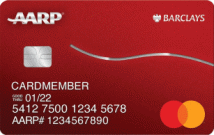

The AARP® Travel Rewards Mastercard® Credit Card from Barclays is a no-annual-fee cash-back credit card designed for consumers who regularly spend on airfare, hotel stays, car rentals and dining but prefer straightforward rewards over airline miles or hotel points. Cardholders earn 3% cash back on eligible airfare, hotel and car-rental purchases, 2% at eligible restaurants and 1% on other qualifying purchases, with no rotating categories and no advertised cap on ordinary rewards. The card also offers a manageable welcome bonus, no foreign transaction fees and an introductory balance-transfer APR for qualifying transfers, although it does not advertise a 0% introductory APR on new purchases. AARP membership is not required to apply, making the card available to qualified applicants outside AARP’s traditional audience, but approval is generally more realistic for people with good to excellent credit, stable income and manageable debt. Overall, this AARP Travel Rewards Mastercard review finds a practical, low-maintenance travel cash-back card with useful core categories, modest ancillary perks and the greatest value for travelers who pay every statement balance in full.
- Excellent Dining Rewards
- Strong Grocery Rewards
- Dining Credits
- Large Welcome Bonus Potential
- No Foreign Transaction Fees
- High $325 Annual Fee
- Credits Require Effort
- Requires Good to Excellent Credit
- Spending Caps on Bonus Categories
- Value Depends on Using Credits
Favorable Details:
- $0 Annual Fee: The card can remain open without a yearly ownership cost, so all earned cash back can contribute to net value.
- Unlimited 3% Travel Cash Back: Eligible airfare, hotel-stay and car-rental purchases earn an elevated rate without an advertised annual spending cap.
- Unlimited 2% Restaurant Cash Back: Eligible restaurant spending earns bonus cash back, adding everyday utility between trips.
- Simple 1% Base Rate: Other qualifying purchases earn 1% cash back without category enrollment or quarterly activation.
- Attainable Welcome Bonus: New cardholders can earn $100 cash back after making $500 in purchases within the first 90 days of account opening under the currently advertised offer.
- No Foreign Transaction Fee: International purchases are not subject to a Barclays foreign transaction surcharge, which supports overseas use.
- Introductory Balance-Transfer APR: Eligible transfers completed within the issuer’s required opening window can receive a temporary 0% APR, although a transfer fee applies.
- Flexible Cash-Back Redemptions: Rewards can be used through available options such as cash back, statement credits, gift cards, merchandise and qualifying AARP membership redemptions.
Unfavorable Details:
- No Introductory Purchase APR: New purchases begin accruing interest under the regular account terms when the grace-period requirements are not met.
- High Potential Variable APR: The advertised regular purchase APR range is costly for cardholders who carry balances from month to month.
- Narrow Travel Definition: The 3% rate centers on airfare, hotels and car rentals rather than a broad travel category that automatically includes transit, cruises, tolls, parking or vacation activities.
- Only 1% on Most Purchases: Groceries, gas, drugstores, utilities and many other common expenses ordinarily earn the base rate unless a transaction qualifies for another category.
- Limited Premium Travel Benefits: The card is not built around airport-lounge access, large annual travel credits, transferable points or luxury hotel status.
- Costly Balance Transfers and Cash Advances: The currently disclosed 5% fees can make these transactions expensive even when a promotional balance-transfer APR applies.
AARP Travel Rewards Mastercard Card Facts Table
| Feature | Details |
| Credit Card Issuer | Barclays |
| Payment Network | Mastercard |
| Rewards Type | Cash Back Rewards Credit Card |
| Recommended Credit | Good to Excellent Credit Score (690-850) |
| Annual Fee or Price | $0 annual fee |
| Rewards | Unlimited 3% on eligible airfare, hotels and car rentals; 2% at eligible restaurants; 1% elsewhere |
| Welcome Bonus | $100 cash back after $500 in purchases within 90 days |
| Intro APR | 0% for 15 months on balance transfers posting within 45 days; no purchase intro APR |
| Regular APR | 20.24%–29.99% variable when reviewed |
| Balance Transfer Fee | 5%, minimum $5 |
| Foreign Transaction Fee | $0 |
| Best For | Travelers wanting simple cash back without an annual fee |
| Notable Benefits | Flexible cash-oriented redemption, no foreign transaction fee and introductory transfer APR |
Unlimited 3% Cash Back on Airfare, Hotels and Car Rentals
The defining feature of the AARP Travel Rewards Mastercard Credit Card is unlimited 3% cash back on eligible airfare, hotel stays and car rentals, a competitive return for a card with no annual fee and no category activation. If a cardholder spends $2,000 on flights, $2,500 on hotels and $500 on rental cars during a year, the combined $5,000 in qualifying travel purchases would produce $150 in rewards, compared with $50 at the card’s 1% base rate. The category is narrower than the broad travel definitions used by some competitors, however, so purchases such as passenger rail, cruises, campgrounds, tolls, parking, taxis, rideshares, travel agencies or vacation rentals may not automatically receive 3%. Rewards depend on the merchant category code transmitted with the transaction, not merely the cardholder’s description of the purchase, and charges processed by third-party platforms, hotel restaurants or travel-package providers may code differently. Consumers should review the current rewards rules and recent transaction details instead of assuming every trip-related expense qualifies.
How the AARP Travel Rewards Mastercard Works
The AARP Travel Rewards Mastercard is an unsecured revolving consumer credit account that allows the cardholder to make purchases up to the available credit line, receive a monthly statement and repay at least the required minimum by the due date. Purchases reduce available credit until payments post, while carried balances may accrue interest at the applicable variable APR and certain transactions, including cash advances and balance transfers, can have separate fees and interest rules. Rewards are earned on eligible net purchases after returns, credits and adjustments, and they do not reduce the amount that must be paid unless they are redeemed through an available option. A statement-credit redemption ordinarily lowers the account balance but does not replace the required minimum payment. The account is not a debit card, prepaid card or travel savings account, so every charge represents borrowed money that must be repaid according to the cardmember agreement, regardless of how much cash back the purchase earns.
$0 Annual Fee
The AARP Travel Rewards Mastercard has a $0 annual fee, removing the recurring break-even hurdle found on many travel rewards cards and making the account easier to justify during years with limited travel. Because there is no annual charge to offset, even modest category spending creates positive gross rewards value: $3,000 in eligible 3% travel purchases would earn about $90, while $3,000 in non-bonus purchases would earn about $30. The absence of an annual fee can also support long-term account age when the card remains useful and is managed responsibly, although cardholders should still monitor the account, protect it from fraud and use it occasionally if permitted by their budget. A $0 fee does not make the card cost-free when a balance is carried, a payment is late, a transfer is completed or a cash advance is taken, so interest and transaction fees remain more important than rewards for anyone who does not pay in full.
No Security Deposit
No security deposit is required because the AARP Travel Rewards Mastercard is an unsecured credit card, meaning approval and the assigned credit line are based on Barclays’ evaluation rather than cash collateral placed by the applicant. This structure differs from a secured card, where a refundable deposit typically supports the limit, and from a debit or prepaid card, where spending draws from money already deposited by the user. An unsecured account can preserve cash for savings and emergencies, but it generally requires a stronger credit profile than an entry-level secured product and does not guarantee a large initial limit. If the account is closed with no balance, there is no card deposit to return; any money owed remains the cardholder’s responsibility. Applicants rebuilding credit should not confuse the lack of a deposit with broad approval standards, because Barclays may still decline an application based on credit history, debt, income or other underwriting factors.
AARP Travel Rewards Cash-Back Program
The card’s rewards program combines travel-focused bonus rates with cash-like redemption flexibility: eligible airfare, hotel stays and car rentals earn 3% cash back, eligible restaurant purchases earn 2% and other qualifying purchases earn 1%. Barclays may display earnings as points even though the product is marketed as cash back, with cash-oriented redemptions generally designed around a value of one cent per point; cardholders should confirm the value and minimum for the option they select because noncash choices can operate differently. Rewards are based on net eligible purchases, so returns and statement adjustments can reduce the balance, while balance transfers, cash advances, fees, interest, money-equivalent transactions and other excluded activity generally do not earn rewards. The program is most effective when the card is used selectively for its 3% categories and paid in full, because one month of interest at a high variable APR can erase the benefit from many months of cash-back earnings.
Unlimited 2% Cash Back at Restaurants
Eligible restaurant purchases earn unlimited 2% cash back, giving the AARP Travel Rewards Mastercard a useful secondary category for dining at home or while traveling. A cardholder who spends $300 per month at qualifying restaurants would charge $3,600 over a year and earn approximately $72, versus $36 at the 1% base rate, creating $36 in incremental annual value. Restaurant eligibility depends on merchant coding, so a hotel restaurant, bakery, food counter inside another retailer, catering business, bar or delivery platform may not always transmit the expected code even when the purchase feels like dining. The 2% rate is respectable but not category-leading, as several no-annual-fee cards offer 3% or more on dining. This benefit is therefore most compelling for someone who wants travel purchases and restaurant spending together on one uncomplicated card rather than a person selecting a card solely to maximize dining rewards.
Barclays Charitable Contribution to AARP Foundation
Barclays advertises a separate charitable-contribution program connected with AARP-branded credit cards, including a contribution for qualifying new accounts and an additional percentage tied to designated eligible purchases during the stated program period, subject to a total donation cap and detailed conditions. This feature may appeal to consumers who value AARP Foundation’s work, but the bank’s contribution is not additional cash back deposited into the cardholder’s rewards balance, is not controlled by the cardholder and should not be treated as a substitute for personal charitable giving or a tax-deductible donation by the cardholder. Eligible purchase categories, campaign dates, activation requirements and annual caps can change, so the current program disclosure should be reviewed separately from the card’s rewards terms. The contribution is best viewed as an ancillary social-impact feature rather than a financial reason to apply, especially when APR, rewards fit, approval likelihood and debt-management needs are more important to the applicant’s overall outcome.
No Rotating Reward Categories
The AARP Travel Rewards Mastercard does not rely on quarterly bonus calendars, category enrollment or changing spending caps, which makes it easier to know when the 3%, 2% and 1% rates should apply. Airfare, qualifying hotel stays and car rentals remain the primary 3% categories, restaurants remain the 2% category and other eligible purchases generally earn 1% unless Barclays updates the program. This fixed structure can be valuable for travelers who dislike monitoring activation deadlines, but simplicity also means there is no periodic opportunity to earn 5% in categories such as groceries, gas or online shopping. Merchant coding still matters even though activation does not, and the rewards rules can exclude particular transactions or intermediaries. The best approach is to store the card for predictable travel and dining purchases, review the first few statements for correct category treatment and use another card when a broader or higher everyday earning rate is available.
Rewards Limits
Ordinary cash-back rewards are advertised as unlimited, so the card does not publish a quarterly or annual dollar cap on the amount of 3%, 2% or 1% rewards that can be earned from eligible purchases. Unlimited earning does not mean every transaction qualifies: balance transfers, cash advances, interest, fees, returned purchases, account-funding transactions, gambling-related activity, money orders, wire transfers and other cash-equivalent or excluded transactions typically do not earn rewards, and credits can reverse rewards previously posted. Practical earning capacity is also constrained by the assigned credit line, available credit, merchant coding and the cardholder’s budget. A consumer should never increase travel or dining spending merely because the reward rate has no cap; earning $30 on a $1,000 purchase still requires repaying the full $1,000, and carrying that amount at the card’s regular APR could quickly cost more than the reward.
Redeeming Rewards
Rewards can generally be redeemed through the Barclays account for options such as cash back, statement credits, deposits where available, gift cards, merchandise and eligible AARP membership purchases, with AARP membership redemptions historically beginning at a stated rewards threshold. Cash-oriented redemptions are usually the clearest way to measure value because a one-cent-per-point rate makes 10,000 points worth $100, whereas merchandise and gift-card values can vary and should be compared before confirmation. A statement credit reduces the account balance but ordinarily does not satisfy the minimum payment due, so the cardholder must still make the required payment by the deadline. Redemption methods, minimums, delivery timing and values can change, and rewards may not be immediately available while a transaction is pending. Travelers who want airline transfers or hotel-partner bonuses should understand that this is principally a cash-back program, not a flexible travel-points ecosystem.
Rewards Expiration
Rewards are advertised as not expiring while the AARP Travel Rewards Mastercard account remains open and in good standing, allowing cardholders to accumulate cash back without a routine monthly or annual expiration deadline. That protection does not necessarily preserve rewards after voluntary closure, issuer closure, default, fraud, misuse or another loss of good standing, and program rules can limit the time or method available to redeem a remaining balance. Before closing or product-changing the account, a cardholder should redeem accessible rewards and confirm whether any pending points have posted, particularly after a large travel purchase or return. Keeping a no-annual-fee account open can be reasonable when it remains secure and useful, but unredeemed rewards should not be treated like an insured bank deposit. Periodic redemption to cash or a statement credit reduces the risk that a future program change or account event will make a large stored rewards balance harder to use.
Welcome Bonus
The currently advertised welcome offer provides $100 cash back after a new cardholder makes $500 in purchases within the first 90 days of account opening, equivalent to a 20% bonus on the required spending before counting ordinary rewards. Reaching the threshold with planned expenses such as groceries, utility bills or a qualifying trip can create useful first-year value, but fees, interest, balance transfers, cash advances, returned purchases and other excluded transactions generally do not count as eligible spending. The 90-day period begins when the account is opened, not when the physical card is activated, so delaying use can shorten the practical window. Applicants should also review eligibility restrictions for prior or existing accounts and save the specific offer shown during application because welcome promotions can vary by channel and change over time. Spending more than the normal budget or carrying a balance to earn $100 would undermine the bonus’s financial value.
Introductory Balance-Transfer APR
The AARP Travel Rewards Mastercard currently advertises a 0% introductory APR for the first 15 billing cycles on balance transfers that post to the account within 45 days of opening, after which any remaining transferred balance is subject to the regular variable APR. A 5% transfer fee with a $5 minimum currently applies, so transferring $5,000 would cost $250 upfront and create a starting balance of approximately $5,250 before new activity; paying that amount over 15 billing cycles would require roughly $350 per cycle to finish before the promotion ends. The card does not advertise a 0% introductory APR on purchases, which means new charges can complicate payoff planning and may be subject to different interest rules. A transfer also uses available credit and cannot usually be made between accounts issued by the same bank. Consumers should calculate the fee, confirm the posting deadline and set a fixed payoff schedule rather than treating the promotional period as permission to postpone repayment.
Variable Purchase APR
The advertised regular purchase APR is currently 20.24% to 29.99% variable, with the assigned rate based on creditworthiness and future movement tied to the applicable benchmark rate and account terms. At a hypothetical 25% APR, carrying an average $2,000 balance for a full year could generate roughly $500 in interest before considering compounding, payment timing or additional purchases, far exceeding the $60 earned if the entire $2,000 qualified for 3% cash back. The regular APR can also apply after the introductory balance-transfer period ends, making an unfinished promotional balance much more expensive. Because the rate range and other terms may change, applicants should rely on the disclosure shown with their offer rather than an older review. This card is financially strongest as a rewards tool for purchases that can be paid in full, not as long-term financing for vacations, dining or emergency expenses.
Paying the Balance in Full
Paying the full statement balance by each due date is the most reliable way to preserve the AARP Travel Rewards Mastercard’s value because it can maintain the purchase grace period and prevent eligible new purchases from accruing interest. Automatic payment of the statement balance can reduce the risk of forgetting a deadline, but the cardholder should keep sufficient funds in the payment account, monitor for returned payments and review every statement for unexpected charges. People using a promotional balance transfer should read the allocation and grace-period rules carefully, since carrying a transferred balance can affect how interest applies to new purchases even when the transfer itself receives 0%. Paying in full does not mean spending the entire credit limit and repaying it later; charges should remain within a written monthly budget. A $150 annual rewards total is meaningful only when it is not offset by interest, late fees, returned-payment costs or purchases that would not otherwise have been made.
Building Credit With the AARP Travel Rewards Mastercard
Responsible use of the AARP Travel Rewards Mastercard may support credit building because an open revolving account can add payment history, utilization data, account age and available credit to a consumer’s credit reports. The most important habits are paying every bill on time, keeping balances modest relative to the credit limit, avoiding repeated applications and maintaining enough cash to repay purchases without relying on future income. A no-annual-fee structure can make the account easier to retain, which may help account age over time, but opening the card can initially add a hard inquiry and reduce average account age. The card cannot erase late payments, collections or other accurate negative information, and no issuer can promise a specific score increase. Consumers whose main goal is credit building should compare the approval requirements with secured or entry-level alternatives before risking an unnecessary hard inquiry.
Reports to the Major Credit Bureaus
Barclays generally reports consumer credit-card account information to Equifax, Experian and TransUnion, allowing payment status, balance, credit limit and account history to influence the cardholder’s broader credit profile. Consistent on-time payments and low reported balances may contribute positive data, while late payments, persistent high utilization, default or charge-off activity can cause serious damage that outweighs the value of any rewards. Reporting dates do not necessarily match payment due dates, so a large balance can appear on a credit report even when it is paid in full a few weeks later. Authorized-user activity may also appear on the user’s reports, subject to issuer and bureau practices, which makes careful account access important. Cardholders should review all three credit reports periodically, dispute genuine errors through the proper process and avoid assuming that one bureau’s data or score perfectly reflects the others.
Keeping Credit Utilization Low
Credit utilization compares the reported revolving balance with the credit limit, and lower usage is generally safer for credit scoring and debt control than routinely approaching the maximum. For example, a $1,500 reported balance on a $5,000 limit equals 30% utilization, while paying the balance down to $500 before the statement closes would reduce reported utilization to 10%, assuming no additional charges post. Consumers can manage utilization by making payments during the billing cycle, setting balance alerts, distributing planned spending across accounts and avoiding large charges immediately before the statement date. The familiar 30% figure is not a magic target or guarantee; lower utilization can be better, while 0% on every account at all times is not required for responsible use. Utilization should never be reduced by draining emergency savings or shifting debt to a more expensive product without considering the total financial cost.
Credit Line Increases
Barclays may review an account for an automatic credit-line increase or allow an eligible cardholder to request one, but the timing, amount and decision depend on factors such as payment history, current utilization, income, total debt, credit reports and the issuer’s internal policies. A higher limit can provide additional purchasing capacity and lower utilization when spending remains unchanged, yet it can also increase debt risk if the cardholder treats the new limit as money available to spend. Some requests may involve a credit inquiry, and the inquiry treatment should be confirmed before submitting because it can vary by process and circumstance. Updating income information accurately and maintaining a strong payment record may help, but neither behavior guarantees an increase. Travelers anticipating a large booking should not rely on a future limit change and should verify available credit before committing to nonrefundable reservations.
Good-to-Excellent-Credit Applicants
The AARP Travel Rewards Mastercard is most appropriately targeted to applicants with good to excellent credit, often interpreted editorially as a FICO score beginning around 670, although Barclays publishes no guaranteed minimum score and approval depends on the full application. A clean recent payment history, low revolving utilization, reasonable debt relative to income, stable earnings and limited recent applications can strengthen a profile, while high balances, numerous inquiries, short history, recent delinquencies or serious derogatory marks can weaken it. A score above 700 does not guarantee approval, and an applicant below 670 is not automatically disqualified, because underwriting considers information beyond a single score. The likely credit limit and APR may also vary with creditworthiness. Consumers should apply because the card fits their travel spending and repayment habits, not merely because an online estimate places their score within a broad recommended range.
Applying for the AARP Travel Rewards Mastercard
An application is generally completed online through the card’s Barclays page and typically requests a legal name, residential address, date of birth, Social Security number, citizenship or residency information, employment details, annual income, housing status and monthly housing cost. AARP membership is not required, though an applicant may be asked for relevant membership information when seeking connected benefits or redemptions. Barclays can make an immediate decision, request identity or income verification, place the application under review or decline it, and a full application will commonly create a hard inquiry on at least one consumer credit report. Before submitting, the applicant should read the exact pricing disclosure, confirm the welcome offer and transfer deadline, check the annual fee and foreign transaction fee, and save a copy for personal records. Information must be accurate and complete, because misstating income, identity or housing details can delay review or create legal and account risks.
Checking Eligibility Before Applying
Prospective applicants should check whether Barclays currently offers a prequalification or eligibility tool that includes the AARP Travel Rewards Mastercard, because issuer tools and participating products can change. A genuine prequalification check often uses a soft inquiry that does not affect typical credit scores, but the screen should explicitly state the inquiry treatment before personal information is submitted. A positive result is only a preliminary indication based on limited information, not a promise of approval, a particular credit limit or the lowest advertised APR; the final application can still trigger a hard inquiry and a separate underwriting decision. If no card-specific check is available, the consumer can review credit reports, reduce revolving balances, correct errors and compare likely approval standards before applying. Avoid unofficial websites that request excessive personal information or present a matching result as guaranteed approval.
Consumers Building Credit
Someone establishing a credit history could benefit from the card’s $0 annual fee, bureau reporting and simple category structure if that person already qualifies and has enough income to pay every statement in full. A small recurring charge, automatic payment and a low reported balance can create steady activity without turning the card into a reason to overspend, while the travel rewards offer extra value only when the underlying trips are already affordable. The main obstacle is accessibility: this is not marketed as a starter or secured credit card, and an applicant with a thin file may face weaker approval odds or a modest limit. A student card, secured card or no-annual-fee product designed for limited history may be a better first step. Building credit should remain the priority, because paying interest on travel purchases does not accelerate positive reporting and can make progress harder.
Consumers Rebuilding Credit
The AARP Travel Rewards Mastercard is generally not the most accessible product for consumers actively rebuilding after recent late payments, collections, charge-offs, bankruptcy or high utilization because its expected approval profile leans toward good or better credit. A person whose reports have stabilized and whose scores have recovered may eventually qualify, but applying too early can produce a hard inquiry without a useful new account. More attainable secured or rebuilding cards can provide bureau reporting while the consumer establishes on-time payments, reduces debt and corrects reporting errors. If approved, the AARP card can be used responsibly as part of a broader rebuilding plan, but it cannot remove accurate negative information or guarantee score improvement. The rewards should be treated as secondary to affordable spending, full or aggressive repayment, emergency savings and avoidance of new delinquency.
First-Time Cash-Back Credit Card Users
The card’s fixed 3%-2%-1% structure and lack of an annual fee make it reasonably easy for a first-time rewards user to understand, especially when the card is reserved for airfare, hotels, car rentals and restaurants. Beginners should still learn the difference between current balance, statement balance, minimum payment, due date and closing date, because paying only the minimum can result in costly interest even when the account remains technically current. Setting automatic statement-balance payments, enabling transaction alerts and checking merchant coding after major travel purchases can reduce avoidable mistakes. A first-time user should also avoid booking a trip merely to capture a bonus, transferring debt without a complete payoff plan or assuming cash back makes a purchase cheaper than paying cash. The card can be beginner-friendly for an applicant who already has the required credit profile, but it is not necessarily a beginner-approval product.
Students and Young Adults
The AARP Travel Rewards Mastercard can serve a financially established student or young adult who qualifies, travels regularly and wants no foreign transaction fees, and an AARP membership is not required to apply. Nevertheless, many students have limited credit history and inconsistent income, making a student-specific card more realistic and sometimes more rewarding for groceries, entertainment, streaming or general purchases. A study-abroad traveler could benefit from Mastercard acceptance and the absence of a foreign transaction fee, but should compare emergency assistance, travel protections and acceptance at local merchants rather than focusing only on the 3% airfare and hotel rate. Young applicants must report income according to application rules and should never inflate it to improve approval odds. A simple student or secured card may provide a safer foundation until the user has reliable earnings, an emergency fund and experience paying statements in full.
International Purchases
The AARP Travel Rewards Mastercard charges no foreign transaction fee, so Barclays does not add the common percentage surcharge to eligible purchases made in another currency or processed outside the United States. The Mastercard network is widely accepted internationally, but acceptance is not universal, and travelers should carry a backup payment method and some local currency where appropriate. When a merchant offers dynamic currency conversion, choosing the local currency usually allows the network to perform the conversion and avoids accepting a potentially unfavorable merchant-provided exchange rate. The absence of a foreign transaction fee does not eliminate ATM fees, cash-advance fees, immediate cash-advance interest, local taxes or merchant surcharges, and using the card for foreign cash withdrawals can be particularly expensive. Travelers should notify or monitor the issuer as appropriate, keep contact information current and review transactions promptly while abroad.
Digital Account Management
Barclays provides online and mobile account access that can be used to view balances, monitor transactions, make or schedule payments, access statements, manage alerts and track rewards. These tools are especially useful when travel charges are large or post in foreign currency, because the cardholder can confirm merchant names, conversion amounts and available credit without waiting for a paper statement. Automatic payments can help prevent missed due dates, while separate alerts for purchases, balances and payments can identify problems earlier, but automation should be reviewed regularly rather than assumed to work indefinitely. Reward-redemption availability and account controls can vary by platform version and account status. Cardholders should use strong unique credentials, enable available multifactor authentication, update the app through official stores and avoid managing the account over unsecured public Wi-Fi without appropriate protection.
Security and Fraud Monitoring
The AARP Travel Rewards Mastercard includes issuer and network security measures such as transaction monitoring, account alerts, identity verification and zero-liability protection for qualifying unauthorized transactions, subject to the account and Mastercard rules. A cardholder should report a lost card or suspicious charge promptly, review pending and posted activity, protect one-time security codes and never provide account credentials to an unsolicited caller or message sender. Zero liability does not excuse participation in a transaction, misuse by an authorized user or delayed reporting that violates applicable requirements, and temporary credits during a dispute can be reversed if an investigation finds the charge valid. Travel can trigger unusual transaction patterns, so current contact information and backup payment methods are valuable. Security features reduce risk but do not replace careful monitoring, secure devices and immediate communication with Barclays when something appears wrong.
AARP Travel Rewards Mastercard vs. Wells Fargo Autograph Visa Card
Both cards target no-annual-fee travelers and offer elevated rewards on travel and restaurants without foreign transaction fees, but the Wells Fargo Autograph Visa generally covers a broader set of 3X categories, including travel, dining, gas stations, transit, popular streaming services and eligible phone plans. The AARP Travel Rewards Mastercard is narrower but offers direct 3% cash back on airfare, hotels and car rentals and may appeal to consumers who prefer Barclays, AARP-related redemptions or the product’s charitable-contribution connection. Autograph points can provide flexible value and the card includes a richer group of advertised Visa travel and phone benefits, while AARP Travel Rewards is easier to evaluate strictly as cash back. Approval for either card generally favors good credit, and exact bonuses and APR promotions can change. Autograph is usually stronger for broad everyday category coverage; AARP Travel Rewards can be the better fit for a traveler whose spending is concentrated in its three core travel categories and who wants a simple cash-back account.
AARP Travel Rewards Mastercard vs. Capital One Savor Cash Rewards Credit Card
The Capital One Savor Cash Rewards Credit Card and AARP Travel Rewards Mastercard both have no annual fee, no foreign transaction fee and a 1% base rate, but their bonus structures address different lifestyles. Savor emphasizes unlimited 3% cash back at eligible grocery stores, restaurants, entertainment and popular streaming services, plus an elevated rate on certain travel booked through Capital One Travel, whereas AARP Travel Rewards pays 3% on eligible airfare, hotels and car rentals booked through qualifying merchants and 2% at restaurants. Savor is typically the stronger everyday card for food and entertainment and may advertise a larger new-card bonus or purchase-APR promotion, while the AARP product lets travelers book eligible airfare and hotels more freely without relying on one issuer portal. Both generally target applicants with at least good credit. Choose Savor for broader household and leisure rewards; choose AARP Travel Rewards when direct travel bookings are the dominant expense and 3% on those bookings matters more than 3% on groceries or entertainment.
AARP Travel Rewards Mastercard vs. AARP Essential Rewards Mastercard
These two Barclays-issued AARP cards share a $0 annual fee, Mastercard acceptance, a 1% base cash-back rate and an AARP-oriented identity, but their bonus categories solve different spending needs. The AARP Travel Rewards Mastercard earns 3% on eligible airfare, hotel stays and car rentals plus 2% at restaurants, making it the logical choice for frequent travelers and diners. The AARP Essential Rewards Mastercard instead emphasizes 3% cash back on eligible gas-station and drugstore purchases and 2% on eligible medical expenses, which can be more useful for routine transportation, prescriptions and health-related spending. Neither card requires an AARP membership merely to apply, and neither should be selected solely because of branding. A household could theoretically find value in both, but two applications and an additional account should be justified by meaningful incremental rewards, strong credit and manageable administration rather than a desire to capture every category.
AARP Travel Rewards Mastercard vs. Traditional Travel Credit Cards
Traditional travel credit cards frequently charge annual fees in exchange for airline or hotel transfer partners, airport-lounge access, travel credits, anniversary rewards, free checked bags, elite-status benefits or stronger insurance protections, while the AARP Travel Rewards Mastercard focuses on uncomplicated cash back with no annual fee. Its 3% travel return is easy to understand and does not require award-chart knowledge, but it lacks the upside that transferable points can provide on premium flights or high-value hotel stays. The AARP card also avoids foreign transaction fees and loyalty-program lock-in, yet its 1% rate outside travel and restaurants can trail flat-rate cash-back cards. Travelers taking a few ordinary trips each year may prefer the AARP card’s simplicity, while frequent or luxury travelers may gain more from a fee-based card after carefully valuing benefits they would actually use. The correct comparison is net annual value after fees, booking restrictions, redemption effort and interest—not the headline rewards rate alone.
Is the AARP Travel Rewards Mastercard Good for Good-to-Excellent Credit?
Yes, the AARP Travel Rewards Mastercard can be a good match for consumers with good to excellent credit who want a no-annual-fee travel cash-back card and expect to pay in full. Its core value is strongest for applicants spending consistently on airfare, hotels and car rentals, with dining providing secondary rewards and international purchases avoiding a foreign transaction fee. Consumers with excellent credit should still compare broader 3% category cards, 2% flat-rate cards and premium travel products because a strong credit profile may qualify them for more valuable alternatives. The card becomes less attractive when most spending occurs in groceries, gas, utilities or general retail, where it typically earns only 1%. Good credit improves potential access but does not make the card automatically suitable; spending alignment, repayment behavior, welcome-offer eligibility and the exact APR disclosure remain decisive.
Is the AARP Travel Rewards Mastercard Good for Beginners?
The AARP Travel Rewards Mastercard is operationally friendly for beginners because it has no annual fee, no rotating-category activation and a clear 3%-2%-1% rewards structure, but its underwriting may be less friendly to people with no established credit history. A beginner who qualifies can simplify management by using the card only for planned travel and dining, setting automatic payment for the full statement balance and enabling purchase and due-date alerts. The welcome bonus requires only $500 in qualifying purchases, yet that spending should come from the existing budget rather than an unnecessary trip. New users must also understand that the card’s balance-transfer promotion does not apply to ordinary purchases and that the regular variable APR can make carried debt expensive. It is a sensible first rewards card for a qualified, disciplined user, while a student, secured or entry-level card may be a better first credit account.
Is the AARP Travel Rewards Mastercard Good for Rebuilding Credit?
The card is usually not the best choice during the early stages of rebuilding because applicants with recent serious negative information or low scores may not match its good-to-excellent-credit target profile. Responsible use could support an improving credit file after approval through on-time payments and low utilization, but neither approval nor score improvement is guaranteed, and the account does not remove accurate derogatory records. A secured card with transparent fees and regular reporting may offer a more attainable starting point, followed by a no-annual-fee rewards card after balances fall and positive history grows. Consumers who have recently recovered should also avoid using travel rewards as justification for new debt. The AARP Travel Rewards Mastercard becomes more reasonable near the end of a rebuilding process, when income is stable, existing utilization is low and every statement can be repaid without financial strain.
Is the AARP Travel Rewards Mastercard Worth It?
The AARP Travel Rewards Mastercard is worth it for the right traveler because the $0 annual fee means there is no recurring fee to recover before rewards create positive value. A cardholder who spends $6,000 annually on qualifying 3% travel, $3,000 at 2% restaurants and $6,000 at 1% elsewhere would earn about $300 per year; using a flat 2% card for the same $15,000 would also earn $300, showing that the AARP card’s advantage depends on how much 3% travel offsets the weaker 1% base rate. Pairing it with a 2% card for non-bonus expenses could improve the result, while the first-year $100 bonus adds value when earned through normal spending. The card is not worth carrying debt at a 20.24% to 29.99% variable APR for rewards of 1% to 3%. It is most worthwhile as a fee-free category card, not as a one-card solution or vacation-financing tool.
Credit Requirements
Barclays does not guarantee approval at a particular score, but good to excellent credit is the most reasonable target for the AARP Travel Rewards Mastercard, with approximately 670 serving only as a broad editorial starting point. Underwriting can consider payment history, revolving utilization, age and mix of accounts, recent inquiries, new accounts, income, housing cost, total debt, identity verification and prior relationships with Barclays. A high score can still accompany excessive obligations or recent risk signals, while a somewhat lower score may sit within an otherwise stable file. Applicants should review all credit reports for errors, pay down card balances where practical, avoid unnecessary applications and calculate whether a new account supports a real spending need. The APR and credit line offered may differ across approved applicants, so qualification should be evaluated separately from whether the resulting terms are financially attractive.
Credit-Building Strategy
A disciplined strategy is to place one or two predictable expenses on the AARP Travel Rewards Mastercard, keep total monthly charges within the checking-account budget, pay the full statement balance automatically and make an early manual payment when a large travel booking would cause high reported utilization. Transaction alerts can identify fraud and spending drift, while balance alerts can prevent the account from approaching its limit. The cardholder should avoid multiple new applications, review credit reports regularly and keep older no-fee accounts open when they remain secure and useful. Rewards can be redeemed periodically rather than accumulated indefinitely, and any welcome bonus should be achieved only through planned purchases. This routine may support healthy credit behavior over time, but scoring models and individual reports vary, so no specific score gain or timetable should be expected.
Avoiding Excessive Debt
Cash back should be treated as a discount on necessary spending, not a reason to expand a travel budget, upgrade a hotel or dine out more frequently. At 3% cash back, a $3,000 trip earns only $90 but still creates a $3,000 repayment obligation, and carrying that balance at the regular APR can generate interest far greater than the reward. Cardholders should set a trip budget before booking, preserve emergency savings, avoid cash advances and use a balance transfer only with a fixed payoff amount that fits within the promotional period. Paying merely the minimum can extend repayment for years, and a large credit limit does not indicate that a purchase is affordable. The most valuable use of the card is charging expenses that could already be paid from available cash, keeping that cash reserved for the statement and collecting rewards without changing normal consumption.
Long-Term Value
The AARP Travel Rewards Mastercard has credible long-term value as a no-annual-fee category card because it can continue earning 3% on core travel bookings and 2% at restaurants without requiring a yearly break-even calculation. Its weakness is opportunity cost: a flat 2% card can double the return on many non-bonus purchases, while broader travel cards can reward transit, gas and streaming or provide insurance and loyalty transfers. As spending changes, cardholders should reassess whether the AARP card remains their primary travel card, becomes a specialized backup or no longer fits, while considering account age and any remaining rewards before closure. Issuer product-change paths, credit-line increases and benefit retention are not guaranteed. The strongest long-term setup may pair this card with a high flat-rate card, using each for its best categories and paying both in full, provided the added complexity remains manageable.
Final Verdict
The AARP® Travel Rewards Mastercard® from Barclays is a solid no-annual-fee credit card for consumers who want direct cash back on ordinary travel expenses without learning airline programs, using an issuer portal or paying for premium benefits. Unlimited 3% cash back on eligible airfare, hotels and car rentals, 2% at restaurants, a $100 welcome bonus after modest qualifying spending, no foreign transaction fee and a temporary 0% balance-transfer APR create a useful package for budget-conscious travelers, and AARP membership is not required to apply. Its limitations are equally clear: most purchases earn only 1%, the travel category is narrower than its name may suggest, premium protections and luxury perks are limited, the balance-transfer fee is high and the regular variable APR makes carried debt expensive. Applicants with good to excellent credit who travel several times a year, value simple cash redemptions and pay every statement in full can receive dependable value, especially when pairing the card with a stronger flat-rate option. Consumers seeking broad everyday rewards, transferable points, major travel insurance or easy rebuilding approval should compare alternatives. Offers and terms can change, so the application disclosure should be reviewed immediately before applying, but under the currently advertised structure, this is a worthwhile specialized cash-back card rather than a complete premium travel solution.